A stopped fan can be easy to miss in a busy restaurant kitchen, especially when the compressor is still running. You might notice less airflow inside the walk-in, an unfamiliar humming noise, or a temperature reading that keeps climbing.
In this article, our team at Universal Services Corp. explains why walk-in cooler and freezer fans stop working and how to address the problem. You’ll find out which fan pauses are normal, what your staff can safely check before arranging service, and when a technician needs to investigate.
Walk-In Fan Troubleshooting: What to Check First
‼️Safety first: Keep fan guards in place, do not touch the blades, and leave electrical panels closed. Do not keep resetting a breaker or controller that trips again. Leave electrical testing, guard removal, and disassembly to a technician.
Some fan problems can be narrowed down with a quick visual or operating check. Use the table below before moving into detailed troubleshooting.
| Symptom | First Action |
| Fans are off with no obvious mechanical blockage | Check the controller mode, alarms, and door status before assuming the fan has failed. |
| Fans stop when the door is open | Close the door fully. If the system uses a door switch, fan operation can resume once the door circuit is satisfied. |
| Fan is running, but airflow is weak | Move boxes, shelving, or stored products away from the evaporator intake and discharge paths. |
| One evaporator fan is stopped while the others run | Check whether the other fans are running. If one fan remains stopped while the others operate normally, arrange service. |
| Ice keeps building around the fan or coil | Do not chip the ice or apply household heat. Recurring ice requires diagnosis of the defrost, drainage, door, or control system. |
| Fans remain off, and the temperature keeps rising | Limit door openings, protect stored products according to your facility procedure, and arrange refrigeration service. |
If these checks do not restore normal operation or the walk-in temperature continues to rise, avoid repeated resets. Our team at Universal Services Corp. can diagnose the fan, electrical circuit, and refrigeration controls. Call us or request service through our contact form for refrigeration repair in NYC.
Evaporator Fan vs. Condenser Fan: Which One Is Not Working?
Fan problems can occur at the evaporator or the condenser. The table below helps you distinguish the evaporator fan in a walk-in cooler or freezer from the condenser fan before you describe the fault to a technician.
| Fan | Location | Function |
| Evaporator fan | Inside the walk-in, usually in a unit mounted near the ceiling. | Circulates room air through the evaporator coil, where refrigerant absorbs heat. |
| Condenser fan | At the condenser on an air-cooled condensing unit. | Moves air across the condenser coil to release heat into the surrounding air. |
The condensing unit can be installed above the walk-in, on a roof, or in a separate mechanical room, so its location varies by system. The equipment labels or your facility’s maintenance records can help identify which unit serves your walk-in.
When Is It Normal for Walk-In Fans to Stop?
Several operating conditions can explain a temporary pause in evaporator fan operation:
- Electric defrost. Evaporator fans normally stop while heaters clear frost from the coil.
- Post-defrost delay. Fans can remain off afterward to let meltwater drain and the coil cool before airflow resumes. Restart depends on the system’s time or temperature settings, so the fans do not necessarily start as soon as defrost ends.
- Door-switch operation. A door switch can stop the fans when the door opens, depending on the system’s configuration.
- Controller settings. Some controllers cycle fans while the compressor is off or pause them during a product-loading mode.
Air-defrost coolers often keep their evaporator fans running throughout the cycle. Check the operating manual to see which functions apply to your equipment.
On some condensing units, pressure controls switch individual condenser fans on and off to maintain the required condensing pressure, particularly in cool weather when less airflow is needed. Heatcraft’s Beacon II manual describes this method of maintaining condensing pressure on multi-fan units.
Investigate further if fan behavior does not match the manufacturer’s operating sequence, the fans fail to restart when expected, or the room temperature keeps rising instead of recovering.
What to Note Before Calling for Service
If the quick checks do not explain the problem, record what the system is doing before service:
- which fan or group of fans has stopped;
- the current room temperature and whether it is still rising;
- any controller alarms or error codes;
- unusual sounds such as humming, scraping, or repeated starting attempts;
- recent changes such as cleaning, a power outage, or motor replacement.
This information helps a technician narrow the problem before testing the motor, controls, and electrical circuit. Avoid removing guards or opening electrical panels to collect additional details.
Why Walk-In Cooler and Freezer Fans Stop Working
A stopped fan can result from a blocked blade, a motor that cannot turn under load, or a missing start command. Its behavior helps narrow the fault, but testing is still needed before parts are replaced.
Ice or Debris Blocking the Fan
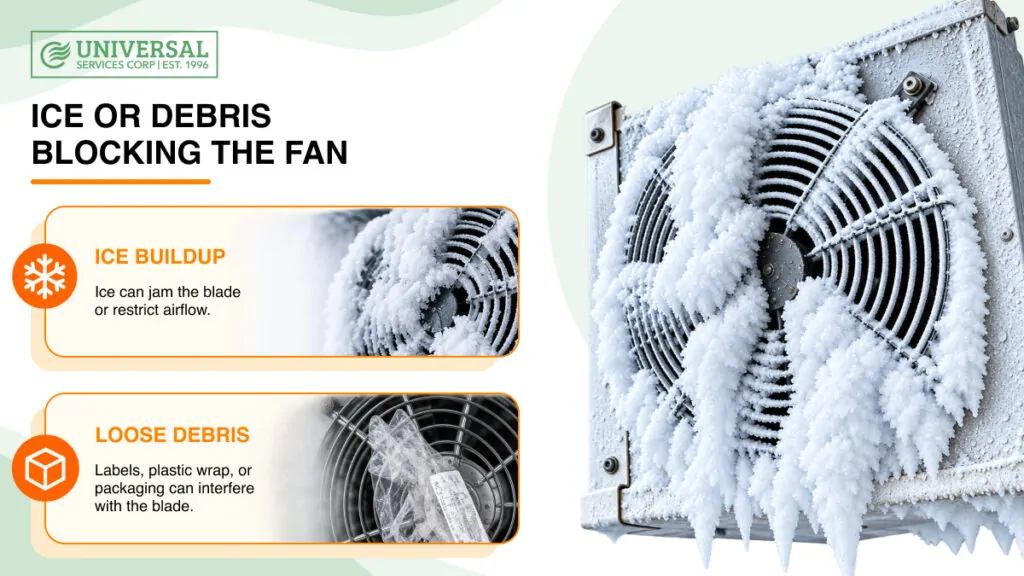
Loose debris: Labels, plastic wrap, or packaging can enter the guard or shroud and interfere with the blade. The fan may hum, attempt to start, or scrape instead of rotating. During service, power must be isolated before an obstruction inside the assembly is removed or the fan is inspected for damage.
Ice buildup: Ice can jam the blade itself or accumulate across the evaporator coil. A frost-packed coil restricts airflow even when the fan is turning, which can leave a walk-in cooler struggling to cool.
Clearing the ice only restores airflow temporarily if the underlying problem remains. Possible sources include a leaking door seal, a blocked or frozen drain, a failed heater where fitted, or incorrect defrost termination. Do not chip ice from the coil or use household heating appliances, since either can damage tubing or wiring.
Worn Bearings or a Failed Fan Motor
Mechanical wear often becomes noticeable before a motor stops completely. Watch for:
- squealing or grinding;
- increasing vibration;
- slow or inconsistent startup;
- a blade rubbing against the shroud.
A motor that stops as it heats and restarts after cooling can be operating its thermal protection, although the reason for overheating still requires diagnosis.
A stationary fan does not automatically mean the motor has failed. A technician checks the supply voltage, any control signal required by the motor design, and the motor’s electrical condition and current draw before replacing it.
If a walk-in freezer fan motor has failed, the replacement must match the required voltage, phase, speed, rotation, and mounting. Blade position within the shroud also affects airflow. On the condenser side, a failed walk-in cooler condenser fan motor reduces heat rejection and can contribute to high-pressure shutdowns where protection is fitted.
A Failed Capacitor or Electronic Motor Module
Fan motors with a permanent split capacitor (PSC) design use a run capacitor. A weak or failed capacitor can cause humming, slow starting, low speed, or intermittent stops. A technician tests the capacitor against the motor manufacturer’s specifications.
Electronically commutated motors (ECMs) use electronic motor controls. Depending on the design, diagnosis involves the power supply, motor module, and any required control signal or speed setting. The motor type determines the test procedure and compatible replacement components.
Power Supply or Wiring Problems
A broken conductor, loose terminal, damaged connector, failed contactor, blown fuse, or tripped protection device can interrupt the fan circuit. A fault in a shared power path can stop several motors, while a problem in an individual branch may affect only one.
The light inside the walk-in may still work because lighting, evaporator fans, and the condensing unit can use different circuits or power supplies. A technician follows the wiring diagram and checks whether voltage reaches the correct points when the fan is commanded on. Electrical faults can also explain why a commercial refrigerator is too warm, so these checks apply beyond walk-in systems.
Faulty Fan Controls, Sensors, or Relays
A healthy motor can remain stationary when the system never provides the correct run command. The components involved depend on which side of the refrigeration system is affected:
- Evaporator side: fan-delay controls, coil-temperature sensors, defrost controls, door-switch circuits, and relays can prevent walk-in freezer fans from coming on when expected.
- Condenser side: fan-cycling switches, pressure transducers, relays, or the main controller can leave a fan off when it needs more heat rejection or make it cycle at the wrong point.
A technician compares the operating state, sensor readings, relay outputs, and system pressures with the wiring diagram and manufacturer settings. Wiring, thresholds, and control sequences vary by model, so a stopped fan alone is not enough reason to replace a controller.
How to Prevent Repeat Fan Problems
A few routine practices can reduce airflow problems and help catch developing fan issues before they disrupt walk-in temperatures:
- Keep boxes, shelving, and stored products clear of evaporator air paths.
- Make sure doors close fully and inspect gaskets or hardware when they no longer seal properly.
- Report new humming, grinding, intermittent fan operation, or recurring ice instead of waiting for the fan to stop completely.
- Keep fan blades and accessible surrounding areas free of debris without removing protective guards.
- Have the refrigeration system maintained according to its operating conditions and manufacturer requirements, including the fans and their controls.
Maintenance needs vary with the equipment and environment, so fan motors should be inspected based on actual condition rather than replaced on an arbitrary schedule.
When to Call for Walk-In Fan Repair
Arrange service if you notice any of the following:
- A commercial freezer fan does not restart during normal operation.
- The walk-in temperature keeps rising.
- Ice keeps returning.
- The motor hums without starting, or the fan runs intermittently and stops again.
Staff should stop trying to restart the equipment if they smell burned insulation, see visible electrical damage, or repeatedly trip a breaker or other protective device. Those signs require electrical diagnosis rather than another reset.
A technician can determine whether the fault is in the motor, power supply, wiring, controls, or another part of the system. If a component needs replacement, it must be compatible with the equipment. The repair should also include checks for normal fan startup, proper airflow, and temperature recovery.
If you need professional help with a walk-in cooler or freezer, our team at Universal Services Corp. can inspect the fan, electrical components, and refrigeration controls to identify the fault. Learn more about our commercial refrigeration repair in NYC and arrange service if the problem requires professional diagnosis.
Conclusion
A successful fan repair is not just about getting the motor to run again. The system should restore proper airflow, complete its normal operating cycles, and bring the walk-in back to a stable temperature. Confirming those results helps show that the underlying problem has been addressed and that the refrigeration system is operating as intended.
Frequently Asked Questions
Can a walk-in cooler or freezer run with one evaporator fan not working?
It may continue cooling for a time, but airflow across the evaporator and through the room becomes uneven. Temperature can vary between different areas of the walk-in, and the remaining fans may not provide enough circulation. A stopped fan should still be diagnosed rather than treated as normal operation.
Should I turn off a walk-in if the fan stops working?
Not every stopped fan requires an immediate shutdown, since some pauses are part of normal system operation. If temperature is rising, electrical protection keeps tripping, or there is a burning smell or visible damage, stop troubleshooting and arrange service. Follow your facility procedure for protecting stored products.
Why did the fan stop working after the motor was replaced?
The replacement motor may not match the required specifications, or there can be an issue with wiring, rotation, blade position, or another part of the circuit. A new motor can also fail to solve the problem if the original fault was elsewhere in the system.
Should all evaporator fan motors be replaced at the same time?
Not automatically. The condition of the remaining motors, equipment design, component compatibility, and manufacturer recommendations should guide the decision. If only one motor has failed, the others should be evaluated rather than replaced solely because they are mounted in the same evaporator assembly.
Can a fan problem increase stress on the refrigeration system?
Yes. Poor evaporator airflow can reduce heat transfer and make temperature recovery more difficult. On the condenser side, insufficient airflow can raise condensing pressure and contribute to protective shutdowns. The exact effect depends on which fan is affected and how the system is controlled.