A walk-in freezer may lose temperature gradually or fail to recover after defrost, deliveries, or repeated door openings. The first warning may be a high-temperature alarm, softer products, or a compressor that runs longer than usual.
When a walk-in freezer is not holding temperature, the same symptom can point to several different problems. Some can be checked by staff, while others require refrigeration testing. This guide explains what to check first, what common temperature patterns may indicate, and when professional repair is needed.
What Temperature Should a Walk-In Freezer Be?
For a restaurant, grocery store, or food-service facility, the standard commercial walk-in freezer temperature is 0°F (-18°C) or below. The FDA recommends keeping freezers at 0°F because properly handled food remains safely frozen at that temperature.
Some facilities use a lower setpoint, such as -5°F or -10°F, to provide additional operating margin during deliveries, frequent door openings, defrost cycles, or periods of heavy product loading. The correct setting still depends on the products stored, the refrigeration system, and the facility’s operating requirements. The number on the controller may differ from temperatures elsewhere in the freezer:
- Supply air changes quickly as cold air leaves the evaporator;
- Return air reflects the air moving back toward the unit cooler;
- Product temperature changes more slowly than air temperature;
- Door-area readings may be warmer than readings near the evaporator.
Probe placement also affects the display. A sensor near the door may show a higher temperature, while a probe in direct discharge airflow may read colder than the rest of the room.
A brief temperature increase after a delivery or scheduled defrost does not automatically mean the freezer is failing. From our experience, recovery is the more revealing indicator. The system should pull the room back toward its setpoint within a reasonable period. Continued temperature rise, slow recovery, repeated alarms, or softening products suggest that the walk-in freezer is not holding temperature and needs closer inspection.
Walk-In Freezer Not Holding Temperature: What to Check First
When a walk-in freezer temperature starts rising, the priority is to confirm the problem and protect the inventory. Staff can complete several safety checks before calling a technician.
- Verify the reading with a separate thermometer.
A faulty sensor, poor probe placement, or controller calibration issue can make the display misleading. Compare the controller reading with an independent thermometer placed away from the door and direct evaporator airflow. - Keep the door closed.
Limit access while the temperature is being checked. Frequent openings allow warm, humid air into the room and make recovery harder. Avoid loading warm or unfrozen products until the cause is clear. - Make sure the door closes fully.
Check for boxes near the entrance, ice on the threshold, damaged gaskets, loose hinges, or a weak door closer. From our experience, even a narrow gap can create continuous heat and moisture infiltration without leaving the door visibly open. - Inspect the evaporator area from a safe distance.
Look for heavy ice on the coil or fan guards, weak airflow, stopped fans, water below the unit, or unusual grinding and rattling sounds. Do not chip ice from the coil or remove electrical panels. - Protect and document the inventory.
Record the air temperature, alarm time, and recent door activity. Check several products with a calibrated food thermometer and move stock to another working freezer when necessary.
Call for service immediately if the temperature keeps rising with the door closed, the compressor short-cycles, the breaker trips, the evaporator fans freeze up, or product begins to soften. These signs point to more than a normal recovery delay after a delivery or defrost cycle.
Common Reasons a Walk-In Freezer Is Not Reaching Temperature
A walk-in freezer may keep running without pulling the room back to its setpoint. Door condition, product placement, ice buildup, controls, and the condenser environment can all reduce cooling performance. Similar airflow, door, condenser, and control problems can also explain why a walk-in cooler is not cooling, although the target temperature is different.
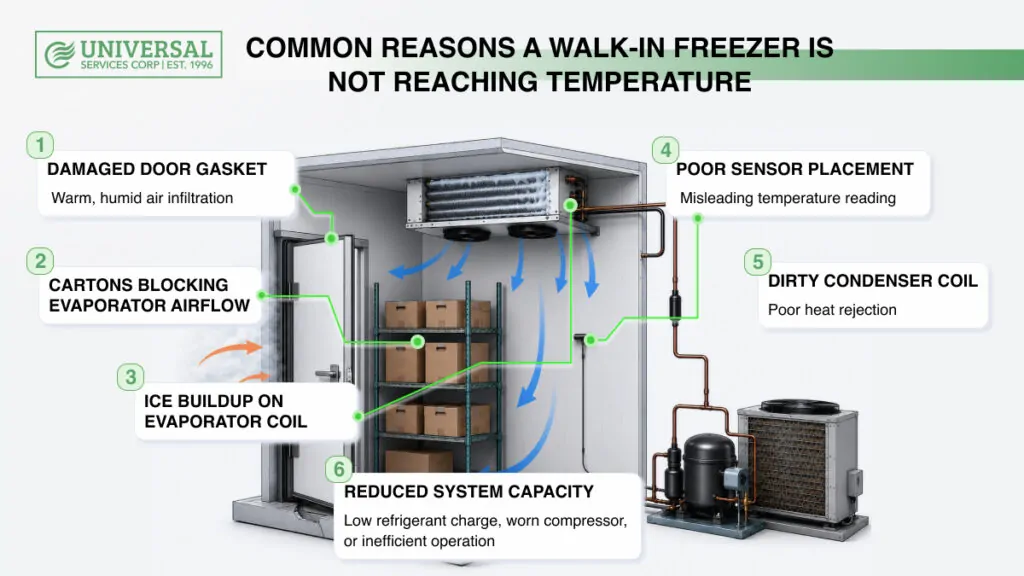
Warm Air is Entering Through the Door
How the heat enters: A torn or hardened gasket may no longer seal against the frame. Misaligned hinges, a weak closer, ice on the threshold, or a box near the entrance can leave a narrow opening. Missing strip curtains increase the heat load during deliveries and busy service periods.
What staff may notice: Our technicians often find that even a small door gap can affect freezer temperature without leaving the door visibly open. Common signs include frost around the frame, water or ice near the entrance, a warmer area by the door, and longer compressor run times during busy hours.
A failed door heater may cause frame icing or sweating, while a pressure-relief problem can make the door difficult to open. Both faults require professional inspection.
Stored Products Are Blocking Airflow
What interrupts airflow: Cartons against the unit cooler, products stacked too high, or poorly placed shelving can block the path between the evaporator discharge and return air. A full freezer is not automatically overloaded, but poorly arranged stock can create warm pockets even while the fans are running.
Where temperatures change: The area near the evaporator may remain cold while products at the front, top, or far end soften. A large delivery of food that is not fully frozen also adds heat faster than the system can remove it.
There is no single clearance measurement for every walk-in. Required spacing depends on the unit cooler, air throw, shelving layout, and room dimensions. Keep the discharge and return paths open and follow the equipment instructions rather than relying on a generic rule.
The Evaporator Coil Is Iced Over
How the defrost cycle should work: During scheduled defrost, heaters warm the coil and melt accumulated frost. A termination control ends the cycle at the correct coil temperature, while the fan delay keeps the fans off until the coil cools again. Meltwater then leaves through a heated, correctly sloped drain.
What can fail: A defective heater, sensor, timer, or controller, termination switch, fan control, or drain heater can leave ice on the coil. Airflow falls as the ice thickens, so the freezer may run continuously without reaching temperature.
Water below the evaporator, ice around the drain pan, stopped fans, or a solid frost pattern all narrow the diagnosis. Heatcraft’s unit-cooler manual identifies fan operation, defrost heaters, fan-delay and termination controls, and frozen drain lines as important inspection points.
Removing visible ice may restore airflow temporarily, but it does not repair the failed component. Chipping ice with a sharp tool can puncture tubing or damage wiring.
The Temperature Control or Sensor Is Giving the Wrong Reading
Why the display may be inaccurate: A sensor can misrepresent room conditions when it is out of calibration, loose, touching a cold surface, or installed in a poor location. A probe beside the door may read warmer than the stored products, while one in direct evaporator airflow may read colder than the room.
What else affects control: Incorrect setpoint or differential settings, service mode, and a controller stuck in defrost can interfere with normal cooling. Compare the display with an independent calibrated thermometer before concluding that the freezer is failing to hold temperature.
A sensor fault can create two different situations: the room may be warm because the controller is not calling for cooling, or the freezer may be operating normally while the display reports a false alarm. A technician can check probe resistance, placement, wiring, calibration, and controller outputs.
The Condenser Cannot Release Heat
What reduces heat rejection: Grease, dust, lint, pollen, and rooftop debris insulate the condenser coil and restrict airflow. A failed condenser fan, blocked intake, poor mechanical-room ventilation, or recirculation of hot discharge air can produce the same result.
A common operating pattern: In New York City, rooftop equipment often struggles under heavy summer load. Condensers near kitchens may also collect a sticky layer of grease and dust much faster than equipment in a cleaner location.
The freezer may improve overnight but struggle during hot afternoons. Other signs include a compressor that rarely cycles off, an unusually hot condenser area, high-pressure shutdowns, or short cycling. Cleaning may correct a dirty-coil problem, although persistent high head pressure requires diagnostic testing. The same condenser and airflow problems can also leave a commercial refrigerator too warm, especially during periods of high kitchen temperature or heavy use.
The Refrigeration System Has Lost Cooling Capacity
Possible system faults: When the door, airflow, defrost cycle, and controller settings look normal, the problem may be inside the refrigeration system. Common findings include a refrigerant leak, restricted filter-drier, faulty expansion valve, weak compressor, bad contactor, voltage issue, or a fan motor that is not moving enough air across the coil.
How technicians separate the causes: Our technicians do not judge a freezer by box temperature alone. A freezer running nonstop at 12°F can have several different faults. Suction and discharge pressures, superheat, subcooling, compressor amperage, coil frost pattern, and airflow readings help show whether the system is short on refrigerant, restricted, overheating, or losing compressor capacity.
Low refrigerant is not something to “top off” repeatedly. A walk-in freezer uses a closed refrigerant circuit, so a low charge usually means there is a leak. The leak must be found, repaired, and tested before the system is charged again.
Work on the refrigerant circuit should be handled by an EPA Section 608-certified technician. After repair, the system should be evacuated, charged to specification, and tested during pull-down to confirm that it can reach and hold temperature.
What the Symptoms Can Tell You
The way a walk-in freezer behaves often gives the first clue about where the problem starts. A single symptom is not a complete diagnosis, but the pattern can help staff describe the issue accurately and avoid wasting time on unrelated checks. The table below summarizes the most common symptoms and their possible causes:
| Symptom | Possible causes |
| Runs constantly, stays warm | Dirty condenser, refrigerant leak, heavy product load, restricted refrigerant flow, or a weak compressor |
| Heavy evaporator ice | Failed defrost heater, timer, or controller issue, faulty sensor, frozen drain, or poor airflow |
| Warm near the door | Damaged gasket, door misalignment, missing strip curtains, weak closer, or frequent openings |
| Uneven temperatures | Blocked airflow, failed evaporator fan, poor shelving layout, or products stacked against the unit cooler |
| Display reading is inaccurate | Poor sensor placement, calibration error, loose wiring, or controller fault |
| Warmer during hot afternoons | Dirty condenser, failed condenser fan, poor ventilation, hot-air recirculation, or insufficient system capacity |
| The compressor starts and stops | Electrical control problem, pressure safety trip, overheating, low voltage, or compressor failure |
| Ice or water below the evaporator | Frozen drain line, failed drain heater, blocked drain, or incomplete defrost |
A freezer running but not freezing often points to lost cooling capacity or severely restricted airflow. A freezer not cold enough only during deliveries may instead be dealing with excessive door load or warm incoming products.
Our technicians also look at timing. A freezer that slowly loses temperature over several days suggests a different fault from one that stops cooling suddenly. Alarm history, compressor run time, recent service work, and the location of ice or warm spots can narrow the inspection before gauges or electrical testing begin.
What Requires Professional Walk-In Freezer Repair
When the door, airflow, and visible ice checks do not explain the issue, professional commercial refrigeration services are required to test the sealed system, electrical components, and controls. The box temperature alone does not indicate if the fault is due to refrigerant loss, restricted flow, a fan motor, or the compressor. A refrigeration technician can inspect:
- Suction and discharge pressures;
- Superheat and subcooling;
- Amperage and operating temperature of the compressor;
- Contactors, relays, wiring, and supply voltage;
- Evaporator and condenser fan motors;
- Defrost heaters, termination controls, and fan delay;
- Restrictions on flow through expansion valve or filter-drier;
- Sensor calibration and probe placement;
- Pressure controls and safety switches;
- Insulation, wall panels, and vapor barriers.
Low suction pressure is not a fault in itself; it can be caused by a refrigerant leak, restricted refrigerant flow, an iced evaporator, or weak airflow. Before service, note when the temperature started to rise, whether the compressor runs continuously, and whether the issue appears after deliveries, defrost cycles, or hot afternoons.
Our technicians at Universal Services Corp. can perform these checks, identify the source of the temperature problem, and recommend the necessary repair. If the freezer continues to warm or cannot return to its setpoint, contact our team to arrange service.
How to Prevent Walk-In Freezer Temperature Problems
Consistent records make walk-in freezer problems easier to catch before the system fails. Record temperature readings at the same times each day and compare them with recent door activity, deliveries, defrost cycles, and alarm history. One high reading after a delivery may not mean much. Repeated slow recovery or longer compressor run times usually deserve attention. Routine checks should include:
- Keep cartons and shelving clear of the evaporator discharge and return-air paths;
- Check that the door closes fully and the gasket contacts the frame on all sides;
- Keep strip curtains straight, clean, and complete;
- Organize deliveries before opening the freezer to reduce door-open time;
- Avoid loading large amounts of warm product at once;
- Clean the condenser based on the actual environment, especially around kitchen grease, rooftop debris, or construction dust;
- Include fan operation, defrost controls, drain pan condition, and heated drain line function during preventive maintenance.
Facilities that operate several types of refrigeration equipment should keep separate maintenance schedules for freezers, refrigerators, and commercial ice machine cleaning.
Automated SMS or email alerts can help managers respond before a temperature problem continues for several hours.
Conclusion
Start by verifying the actual temperature with an independent thermometer and limiting access to the freezer. Protect the inventory first, then check for a door that does not seal, blocked airflow, or visible ice around the evaporator. If the temperature continues to rise or the system cannot recover after the door remains closed, waiting for a complete breakdown puts more product and equipment at risk.
If you need accurate diagnostics or professional walk-in freezer repair services, our team at Universal Services Corp. will be glad to assist. Our technicians can inspect the freezer, identify the source of the temperature problem, and recommend the right repair before a small issue turns into a larger failure.
Frequently Asked Questions
Why is my walk-in freezer running but not freezing?
The freezer may be losing cooling capacity or airflow even though the compressor is still running. Common causes include blocked airflow, an iced evaporator coil, a dirty condenser, a failed fan motor, a refrigerant leak, or a weak compressor. Product stacked against the evaporator can create the same symptom even when the refrigeration system is operating. A technician may need to compare airflow, coil condition, refrigerant pressures, and compressor performance to identify the cause.
How long should a walk-in freezer take to reach temperature?
There is no fixed pull-down time for every walk-in freezer. Recovery depends on the room size, starting temperature, product load, door activity, outdoor conditions, insulation, and refrigeration capacity. An empty freezer cooling from room temperature behaves differently from a loaded unit recovering after a delivery or defrost cycle. The more important sign is whether the temperature continues moving steadily toward the setpoint.
Why is my walk-in freezer not getting cold enough after defrosting?
Slow recovery after defrost usually points to remaining ice, weak airflow, or a defrost-control problem. The freezer should begin cooling again once the cycle ends and the evaporator fans restart. Possible causes include a fan-delay fault, excessive defrost duration, blocked airflow, or insufficient refrigeration capacity.
Can a dirty condenser cause a commercial freezer not to freeze?
Yes, a dirty condenser can prevent the freezer from removing enough heat. Dirt, grease, and debris restrict airflow and increase compressor load. The freezer may run continuously, struggle during hot weather, or shut down on high pressure.
Should I turn off a walk-in freezer if it is not cooling?
Turn it off if there is a burning smell, severe mechanical noise, repeated breaker trips, or ice around moving fan blades. Otherwise, keep the door closed, protect the inventory, record the temperature, and contact a refrigeration technician before shutting the system down unnecessarily.
Can Partially Thawed Food Be Refrozen?
Yes, partially thawed food may be refrozen if ice crystals remain or the product is 40°F or below. USDA guidance also recommends considering the food type, time above the required temperature, packaging condition, and the facility’s food-safety procedures.