
Ice production using ice machines in the food industry and other businesses is a highly regulated process due to the requirements of health and safety inspections. That is why business owners often raise questions about commercial ice machine maintenance to ensure that the machine works properly and does not lead to costly breakdowns, while the ice is sanitary, free of bacteria, mold, unpleasant odors, and tastes.
In this article, read tips on cleaning ice machines from HVAC service experts and official recommendations from the manufacturers of the most popular ice machines, and get the answer to the important question: how often to clean an ice machine.
The Importance of Regular and Proper Cleaning of an Ice Machine
Since the FDA classifies ice as a food product, the same regulations apply to it as to food. Meanwhile, ice makers are classified as food-contact surfaces, which means they are subject to the same sanitation requirements as any food preparation surfaces.
Although it may initially seem that an ice maker only comes into contact with water and is safe, in reality, without regular maintenance, contaminants such as mineral deposits and biofilm can accumulate inside. These types of contaminants cause not only unpleasant odors and off-flavors but also harmful bacteria. Among the most relevant sanitation standards and codes that are commonly violated during ice production in an ice machine are:
- Code 10F — unclean food-contact surfaces
- Code 2G — ice/food at unsafe temperatures
An example of penalties from inspections is the assessment of 5 violation points and a fine of approximately $250 for a dirty ice machine. Additionally, the result of unsatisfactory health inspections at your establishment is inspectors posting a B or C grade on your windows.
Therefore, the most important reasons for regularly cleaning your ice machine are:
- Failure to pass health inspections
- Significant fines (starting at $250)
- Equipment damage and unexpected downtime
- Loss of customer trust if contaminated ice is served
- Breakage of expensive parts (from $1,500 to $4,000)
Why is Professional Cleaning Important?
As experts in ice machine maintenance who understand all the nuances of these systems, we do not recommend performing a deep clean yourself for the following reasons:
- Insufficient cleaning. Concerned about damaging the equipment, you will likely only perform a superficial cleaning without disassembling the parts. Performing only this type of superficial cleaning will eventually lead to internal contamination of the ice machine and the risk of parts breaking.
- Loss of the manufacturer’s warranty. Ice machine manufacturers typically have strict requirements for system cleaning and approved disinfectants. Even the slightest violation of these requirements can result in the loss of the machine’s warranty.
- Risk of damage to parts during deep cleaning. If you are determined to disassemble the ice machine to clean it properly, a lack of knowledge and skill could lead to accidental damage to parts — for example, by chipping ice off the evaporator or mixing chemicals — and replacing these parts can be quite expensive.
How Often Should Commercial Ice Machines Be Cleaned
Most manufacturers align their recommendations with sanitation standards and advise performing a deep cleaning and disinfection at least every six months. However, in establishments with frequent use or specific environments, such as hotels, bakeries, hospitals, or busy bars, cleaning is recommended much more frequently, from once a month to once a quarter.
| Establishment Type | Recommended Cleaning Frequency |
| High Load Environments (Bakeries, pastry shops, meat processing plants) | Once a month |
| High Customer Traffic (Busy bars, cafes, fast-food chains) | Once every 3 months |
| Strict Sanitation Standards (Hospitals, clinics, medical centers) | Monthly to Quarterly (Based on risk protocols) |
| Hospitality Sector (Hotels, hostels, resorts) | Every 1 to 3 Months (Depending on seasonality) |
| Standard Commercial Environments (Offices, non-food retail stores) | Every 6 months |
Deep Cleaning a Commercial Ice Machine on Your Own
Before performing any maintenance on the ice machine, you should first review the manufacturer’s instructions or manual to learn all the details and the cleaning and maintenance schedule. If you do have experience dealing with HVAC systems and decide to perform a deep cleaning on your own, follow the step-by-step instructions compiled by our certified experts:
1. Prepare for cleaning by turning off the unit and placing a warning sign.
2. Remove all remaining ice and melt it in the cooling container.
3. Disassemble the parts by removing the detachable trays, containers, and filters.
4. Remove scale by soaking the parts in a special solution approved by the manufacturer.
5. Thoroughly wash all surfaces and apply a food-safe disinfectant.
6. Rinse the system with clean water and reassemble the parts.
💡Pro tip for busy establishments! If it’s inconvenient for you to clean the machine before or after your shift, or if you need to do it during open hours, schedule a deep cleaning for off-peak periods to minimize downtime.
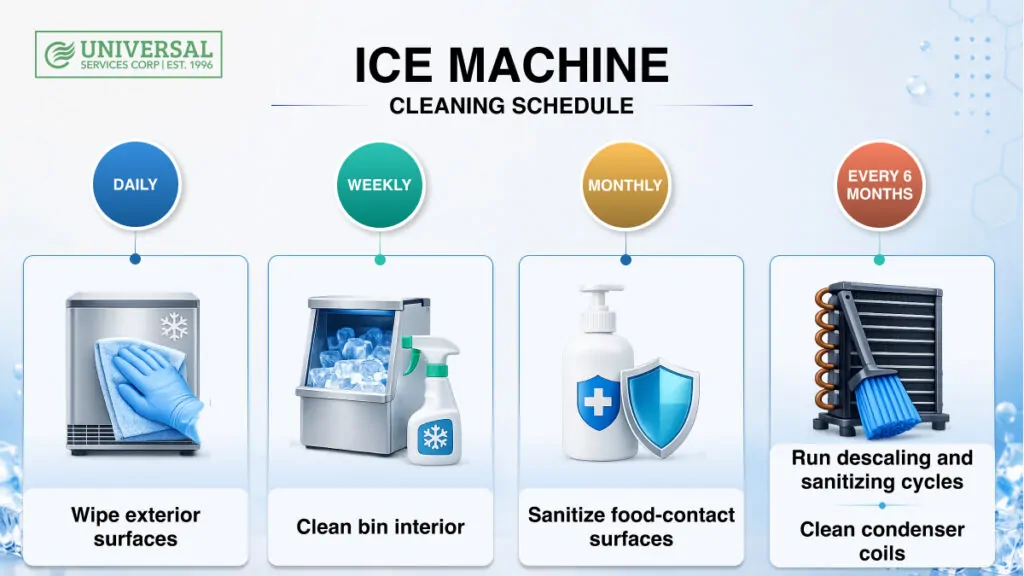
The standard and general ice machine cleaning schedule recommends:
1. Daily wiping,
2. Weekly cleaning of the interior bins,
3. Monthly sanitization of surfaces,
4. Deep cleaning every six months, including descaling and cleaning of condenser coils.
Signs Your Commercial Ice Machine Needs Cleaning
In order to determine on your own whether it’s time to clean the ice machine or if you need to call a technician, you don’t have to wait for a set period of six months; just perform one simple monthly check. When wiping down the system, check the interior for white chalky buildup. Its presence indicates that the descaling procedure should be performed earlier than scheduled. By wiping down the containers, replacing the cartridges, preventing the growth of algae and biofilm, and most importantly, checking for scale buildup, you can identify and prevent problems before they turn into costly repairs.
What Causes Ice to Become Contaminated in an Ice Machine?
It is clear that, for the most part, ice in ice machines becomes contaminated due to improper or irregular maintenance. The main problem, regardless of the ice machine model, is that once contamination occurs, it’s hard to notice until it’s too late. That is why regular inspection and cleaning are so important. Without them, the contamination will spread, and the only solution will be to eliminate it completely. This will require special cleaning agents and their application in the deeper parts of the system; otherwise, you won’t be able to remove all traces of mold or bacteria.
Best Practices for Cleaning a Commercial Ice Machine
In order to avoid any issues with maintaining hygiene and cleaning your ice machine, follow these simple tips, which will significantly improve all aspects of using your ice machine:
- When scooping ice, use only clean and dry spoons. Always use a dedicated spoon and keep it in a clean holder. Never handle ice with your bare hands or cups!
- Keep the area around the machine clean and clear. Food and cleaning supplies are not the best things to have next to an ice machine. Having them nearby could get you fined.
- Ensure that staff are properly trained. Check whether the staff at your establishment who use the ice machine or work near it are aware of hygiene protocols. If not, conduct a training session.
- Conduct regular checks or at least ask your team if there are any foreign odors or colors in the ice, or if there are any leaks from the machine. Don’t wait for customers to report these issues.
- Conduct mini-inspections during every cleanup at workplaces, not just once a month.
The Importance of Staff Training on Cleaning Commercial Ice Machines
The cleanliness of equipment and its compliance with sanitary standards depend directly on you or your staff, and on the training you provide accordingly. It stands to reason that staff trained in basic food hygiene rules will be more likely to identify contamination issues with the ice machine at an early stage. Furthermore, such employees will properly clean the equipment and maintain high standards not only for the ice machine but throughout the entire establishment.
Hygiene training will help avoid the most common mistakes made by food service establishments. Namely, the belief that equipment producing a clean product does not get dirty and does not require close attention. This is exactly the case: adhering to proper hygiene isn’t as big a problem as simply ignoring it. Proper training is the initial step toward establishing a food safety culture in your workplace.
Cleaning a Commercial Ice Machine with Universal Services Corp.
As we’ve already mentioned, cleaning an ice machine without the necessary skills can result in a poor-quality clean or, worse, costly breakdowns. To avoid the bother of cleaning a commercial ice machine yourself and putting your money at risk, call in the professionals.
Since 1996, Universal Services Corp. has been a trusted provider of cleaning and maintenance services for commercial ice machines serving restaurants, bars, hotels, and food service establishments in New York City. Our certified technicians will perform a complete cleaning of your commercial ice machine for just $650.
By entrusting maintenance to trained specialists, you are guaranteed that the manufacturer’s technical requirements will be met, warranty obligations fulfilled, and your equipment’s maximum efficiency preserved.
Additionally, you can set up an individual service contract with us for your ice machine at the frequency you need, in order to keep it running at its best and prevent costly breakdowns.
Each manufacturer has unique cleaning protocols and approved chemicals. That is why our technical specialists are trained on the most common models, such as Mitsubishi, Daikin, Manitowoc, Hoshizaki, Follett, Ice-O-Matic, Avantco, and Scotsman.
Order the highest-quality cleaning service right now!
Conclusion
Sanitary standards and ice machine manufacturers recommend cleaning commercial ice machines once every six months. However, some establishments have specific operating conditions and environments that may require much more frequent cleaning. This is because high usage causes the machine to become contaminated twice as fast, and the air may contain specific bacteria. Given these conditions, cleaning may be necessary almost every month.
To perform a deep cleaning on your own, you need specific knowledge and must follow clear instructions; otherwise, you may leave bacteria behind, damage parts, and void the manufacturer’s warranty. That is why we offer you the services of certified HVAC system maintenance specialists from Universal Services Corp. Call us right now and avoid problems with your ice machine!
Frequently Asked Questions
What bacteria and illnesses are associated with dirty commercial ice machines?
Lack of regular disinfection of the ice machine leads to the formation of dangerous foodborne pathogens. The ice maker is just as much a surface that comes into contact with food as any other. The most common microorganisms found in neglected ice makers are norovirus, Listeria, Salmonella, and E. coli. Ice contaminated with these bacteria can cause severe gastrointestinal illness, food poisoning, and infections among your customers.
What are the legal and business risks of serving contaminated ice?
Food poisoning linked to your establishment’s ice machine will result in fines for violating health and safety regulations. You could face costly lawsuits for health damages, permanent closure of your business by the local health department, and a hit to your brand’s reputation. Nowadays, even a single public mention of food poisoning can permanently drive customers away from your restaurant, bar, or hotel.
Why does my ice machine have slime or mold if it only processes clean water?
The growth of slime in ice machines, often referred to as biofilm, is typically caused by airborne yeast and fungi. In food industry environments, yeast from bread baking, beer taps, and airborne food particles is sucked into the machine by its cooling fans. Once inside, this yeast actively multiplies in the dark, damp environment, forming a sticky biofilm that traps bacteria and grows rapidly.
Does a water filter eliminate the need for regular ice machine descaling?
Not really, a water filter doesn’t replace deep cleaning and descaling. Of course, high-quality water filters take out chlorine, sediment, and some minerals really well, but they can’t completely stop scale buildup over time, and they certainly can’t stop bacteria from getting in. A filter extends the life of your machine, but you still need to descale and sanitize it according to the schedule.