Before you budget for a walk-in cooler installation, check what the supplier’s price covers. Some listings include only the insulated box, so you’ll need to buy refrigeration separately. Even a package with refrigeration still needs assembly, connections, and startup.
For a restaurant opening or a cold storage expansion, budget for electrical or drainage work if the cooler location lacks suitable connections. If you’re replacing a cooler, ask the installer which connections suit the new equipment and how much removal costs. Below, we’ll compare equipment and labor costs by size and show what goes into an installation quote for your space.
How Much Does Walk-In Cooler Installation Cost?
Equipment and installation labor total $9,700 to $24,300 per cooler in the examples below. Use the range as a starting point for a walk-in cooler installation in NYC in 2026. A full quote accounts for the refrigeration system your cooler needs, installation materials, and any work at your site. If the crew needs to run a new electrical circuit or carry panels down a narrow basement stairwell, include the extra work in your budget.
| Cooler size | Equipment cost | Installation labor allowance | Equipment + labor estimate |
| 6×6 ft | $7,700 | $2,000 to $4,000 | $9,700 to $11,700 |
| 6×8 ft | $8,400 | Quote required | Quote required |
| 8×10 ft | $9,300 | $3,000 to $5,000 | $12,300 to $14,300 |
| 10×10 ft | $10,400 | $3,500 to $6,000 | $13,900 to $16,400 |
| 10х12 ft | $10,900 | Quote required | Quote required |
| 12×20 ft | $15,300 | $6,000 to $9,000 | $21,300 to $24,300 |
The equipment column uses Astra walk-in cooler packages as retail pricing examples. Each package includes an insulated box, floor, door, and Turbo Air remote refrigeration. Prices reflect supplier listings on November 10, 2026, and the table rounds each equipment price to the nearest $100. Sizes show nominal width × length. The exterior height is 7 ft 7 in.
The table combines retail equipment prices with illustrative labor allowances. Materials, connections, and site work need separate pricing. The full budget also covers applicable taxes, permit fees, and any demolition or lifting. Delivery and unloading depend on the supplier’s terms and destination.
Divide the combined equipment and labor estimate by the cooler’s nominal floor area. For a 6×6 ft cooler, $9,700 to $11,700 divided by 36 sq. ft. comes to about $269 to $325 per sq. ft. For a 10×10 ft cooler, $13,900 to $16,400 divided by 100 sq. ft. gives $139 to $164 per sq. ft.
Both coolers need door hardware and system startup. Those costs do not rise in proportion to floor area, so use the figures as a rough comparison between sizes.
Walk-In Cooler Installation Cost Breakdown
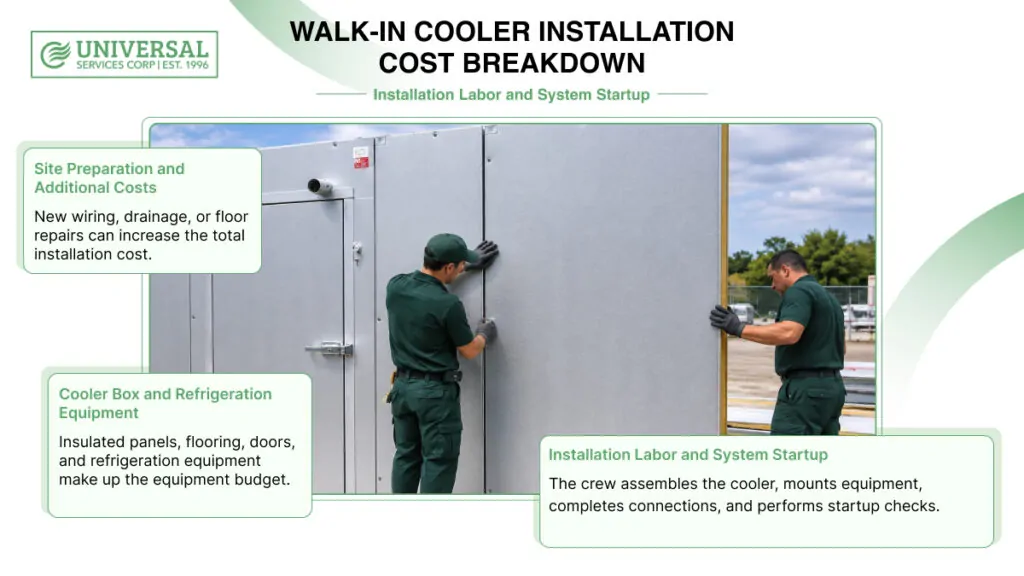
If the space needs new wiring, drainage, or floor repairs, that work adds to the cost of buying and installing the cooler.
Cooler Box and Refrigeration Equipment
During a walk-in cooler repair visit, the technician checks whether the refrigeration system needs repair or replacement. If the system needs replacing and the existing box is sound, keeping the box avoids the cost of buying and assembling a new enclosure. Loaded carts and pallet jacks concentrate weight on small wheels. If the wheel loads exceed the standard floor’s rating, budget for a stronger floor.
Installation Labor and System Startup
The installation crew assembles and seals the box, aligns the door, mounts the equipment, and completes the electrical and condensate connections the system requires. The materials budget also covers refrigerant piping, insulation, fittings, and other installation materials.
If the system needs refrigerant charging on site, the refrigeration technician tests for leaks, evacuates the circuit, and adds refrigerant according to the manufacturer’s instructions. During startup, the technician checks the controls, drainage, door seals, and whether the cooler reaches the target storage temperature.
Site Preparation and Other Project Costs
A site visit shows whether the existing floor, power supply, and drainage are ready for the cooler. Additional project costs can include:
- Base preparation: leveling, repairs, or reinforcement where the existing floor is unsuitable.
- Electrical work: new circuits, wiring, disconnects, or extra service capacity.
- Condensate drainage: a new drain route or pump where required.
- Delivery and access: freight, unloading, stairs, restricted passages, or lifting equipment to the roof.
- Removal: dismantling the old cooler, refrigerant recovery, and disposal.
- Approvals: design work, applicable permits, and inspections for the planned installation.
In NYC, a cooler can fit the room while its panels are too large to turn through the basement stairwell. Door widths and stair landings affect how the crew gets everything inside and how much handling the job needs. Rooftop equipment adds lifting work, while restricted delivery windows and limits on noisy work affect the schedule.
Total project budget = equipment + installation labor + installation materials + required site work + additional delivery charges + applicable taxes and permit fees.
Do not add separate material or delivery charges when the supplier’s or contractor’s quote already covers the same costs.
What Affects Walk-In Cooler Installation Costs in NYC?
An 8×10 ft cooler receiving warmer deliveries throughout the day has more product heat to remove than an identical box holding prechilled stock.
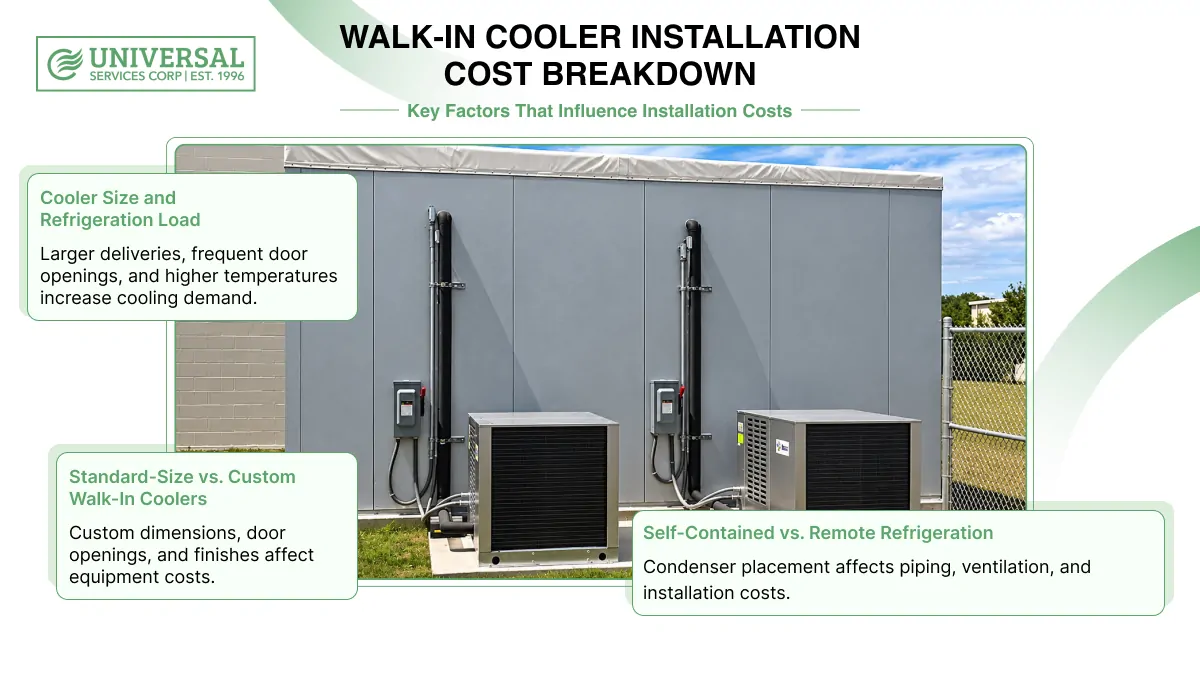
Cooler Size and Refrigeration Load
Floor area determines how much room you have for shelving and loading aisles. A taller box uses more wall panel material even when the footprint stays the same. When choosing the height, check how many usable shelf levels you gain after leaving room for airflow around the evaporator.
The installer sizes the refrigeration system with a heat-load calculation. Daily operating conditions affect the load in several ways.
- Larger deliveries of warm stock bring more heat into the cooler.
- Frequent or prolonged door openings let more warm air into the box.
- A hotter room increases heat gain through the insulated walls and ceiling.
If the package you priced falls short of the calculated load, the installer quotes a system with more cooling capacity.
Standard-Size vs. Custom Walk-In Coolers
Manufacturers offer factory-made panels for standard and custom walk-in coolers. Standard boxes come in catalog sizes. For a custom layout, the manufacturer adjusts the footprint, height, or door opening to suit the room.
If a standard box sits too high for a low beam, the manufacturer specifies shorter wall panels. A door opening onto a wider aisle gives a loaded cart more room to turn. A wider door changes the panel opening and hardware. The equipment price also reflects options such as stainless steel finishes and reinforced flooring.
Self-Contained vs. Remote Refrigeration
Condenser placement affects the piping route, equipment access, and where the system releases heat.
| Cost factor | Self-contained refrigeration | Remote refrigeration |
| Refrigerant piping | A self-contained package reduces piping work on site. | Longer routes require more pipe, insulation, and installation time. |
| Condenser heat | An indoor condenser releases heat into the room. Budget for ventilation upgrades if the room needs more airflow to carry away condenser heat. | The installer places the condensing unit outdoors or in another space with adequate airflow and service access. |
| Placement and access | The package needs enough mounting space and ventilation. | Rooftop placement adds lifting and access work. |
Remote refrigerant line length and vertical rise must stay within the equipment manufacturer’s limits.
Indoor vs. Outdoor Installation
An indoor installation needs enough ceiling height and working clearance for assembly, equipment airflow, and future service. A top-mounted unit needs clearance above the box for airflow and service. Higher room temperatures increase the cooler’s refrigeration load. The door position must also accommodate daily loading routes.
Outdoor placement frees indoor floor space and requires weather protection and refrigeration specified for summer heat and winter temperatures. A new supporting base adds construction work, while longer power and drainage routes increase material and labor costs. Direct sunlight increases the heat entering the cooler.
How to Reduce Walk-In Cooler Installation Costs
Plan the layout and required site work before ordering equipment to limit changes during installation.
- Choose a suitable standard size. Standard dimensions can avoid the extra fabrication needed for a custom layout.
- Size refrigeration to the calculated load. Matching refrigeration capacity to the heat load helps avoid paying for an oversized system.
- Choose short, accessible utility routes. Direct routes need less piping and wiring and take less work to install.
- Finish agreed site preparation before delivery. A level base, clear access, and ready connections help prevent interruptions and repeat visits.
Ongoing Walk-In Cooler Costs
Keep electricity, scheduled servicing, and a repair reserve separate from the installation budget. Electricity use depends on ambient temperature, product loading, door activity, and refrigeration efficiency. Use metered cooler consumption or manufacturer energy data for comparable operating conditions to estimate the monthly energy charge:
Monthly energy charge (USD) = monthly electricity use (kWh) × applicable energy rate (USD/kWh). Add other applicable tariff charges separately.
During commercial refrigeration maintenance, technicians check the condenser and evaporator, drainage, fans, controls, and door seals. Cleaning frequency depends on the manufacturer’s instructions and exposure to grease, dust, and outdoor debris.
Keep a reserve for repairs outside warranty coverage, such as door gasket replacement when the warranty excludes worn seals. Warranty terms also determine whether you pay for labor or service travel. Adjust the reserve as the cooler ages.
How to Get an Accurate Walk-In Cooler Installation Quote
Prepare your storage requirements and site information before requesting an estimate.
- Record dimensions and loading requirements. Measure the available length, width, and clear height, allowing for actual equipment dimensions and service clearances. Describe the products, incoming temperatures, daily loading quantities, delivery frequency, and maximum stock you expect to hold.
- Identify preferred equipment locations. Mark where the cooler and condensing unit should sit. Include door positions and the route between the equipment, especially for remote refrigeration.
- Share photos and site details. Document the site details your installer needs for a walk-in cooler quote with photos of the installation area, electrical panel label, and delivery route. Include doorway, stairwell, and overhead clearances, plus the supply voltage and phase if you know them.
- Arrange a site assessment. After the installer checks the space, compare proposals with the same equipment specifications, scope of work, exclusions, and warranty coverage. Confirm whether installation materials, delivery, unloading, and required site preparation are included.
If you have a cooler model in mind, bring the spec sheet to the site visit. Our team at Universal Services Corp. checks how the equipment fits and prepares a quote for your walk-in cooler installation in NYC or Long Island.
Contact us to arrange a site visit. We’ll review the equipment layout with you and explain what work the space needs before installation.
Conclusion
Choose a cooler for the stock you need to hold between deliveries. Allow for shelving and leave enough room to turn a loaded cart. Once you choose the box and refrigeration system, price the work to bring the equipment in, connect it, and get the cooler running.
At Universal Services Corp., we plan for service access from the start. A technician needs room to reach the evaporator and condensing unit once the cooler is in use.
Frequently Asked Questions
Can buying a used walk-in cooler reduce the total installation cost?
Yes, but dismantling, transport, inspection, and reassembly add costs. Repairs or modifications at the new site reduce the savings from buying used.
How long does walk-in cooler installation take?
Installation time depends on the cooler and site conditions. Manufacturing, delivery, and approvals add lead time. Load products after startup checks confirm the specified storage temperature.
Can I install a walk-in cooler myself to save money?
Panel assembly is only part of the job. Budget for the required electrical, refrigeration, and drainage work, and check the manufacturer’s installation and warranty requirements.
Does a walk-in freezer cost more to install than a cooler?
Generally, yes, for comparable sizes and sites. Low-temperature refrigeration, insulated flooring, defrost equipment, and heated door components typically increase equipment and installation costs.