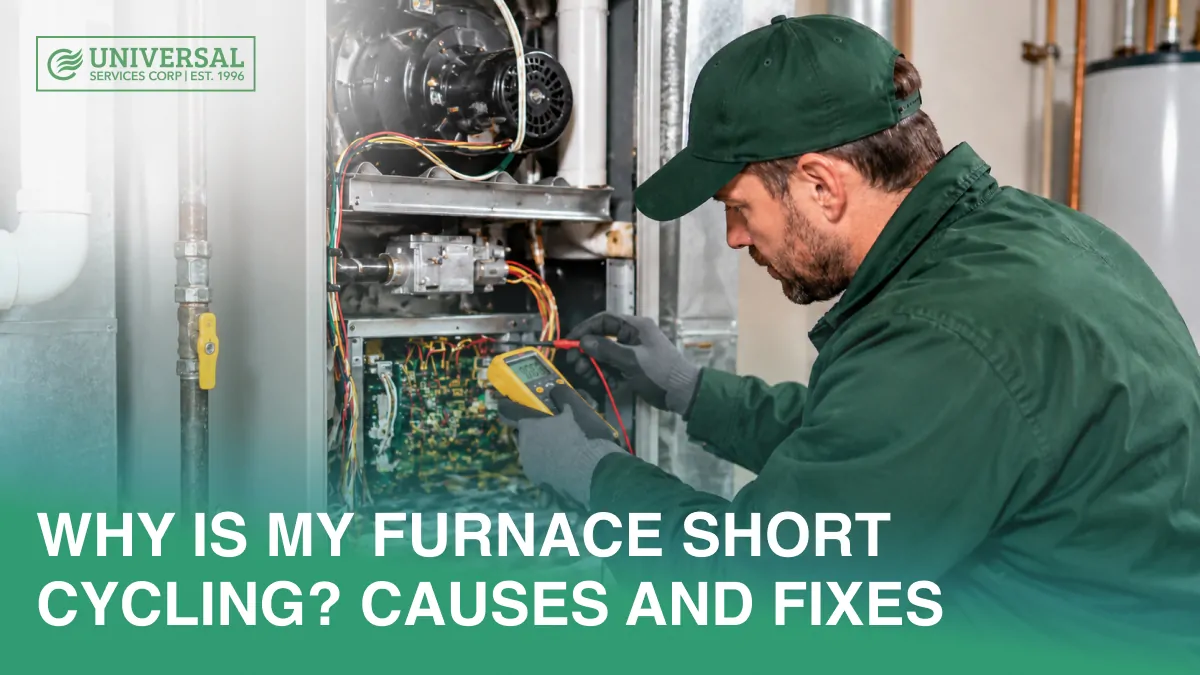
If your furnace keeps turning on and off before the indoor temperature reaches the thermostat setting, the heating cycles are ending too soon. The shutdown timing gives you the first useful clue: burners that stop seconds after ignition require a different troubleshooting path from burners that shut off after several minutes while the blower keeps running.
In this guide, our technicians at Universal Services Corp. explain what to check first, what the shutdown pattern can reveal, and when to stop troubleshooting and call for service.
What Is Furnace Short Cycling?
Furnace short cycling is a repeated pattern of unusually brief heating cycles. A control or safety shutdown can interrupt heating before the room reaches the thermostat setting. An oversized furnace can also reach that setting too quickly, shut off, and restart soon afterward.
A blower that continues briefly after the room reaches the set temperature is usually completing a normal shutdown sequence.
How Long Should a Furnace Cycle Last?
No fixed runtime suits every furnace. Outdoor temperature, heat loss, thermostat settings, equipment capacity, and heating stage all affect cycle length. Longer runs during very cold weather are generally normal because the building loses heat faster.
Use the furnace’s recent behavior as your baseline instead of treating 10 or 15 minutes as a universal rule. One brief cycle alone does not establish a problem. A sudden shift to repeated short runs deserves attention, particularly if the indoor temperature no longer reaches or holds the setpoint.
How to Fix Furnace Short Cycling: What to Check First
‼️If you smell gas, hear hissing near a gas line, a gas or carbon monoxide (CO) alarm sounds, or you see smoke or fire, leave immediately and call 911 from outside. Stay out until responders allow reentry. National Grid warns against using switches, thermostats, or phones indoors during a suspected gas leak.
The U.S. Consumer Product Safety Commission identifies headache, dizziness, and nausea as possible CO symptoms. If you suspect exposure, leave and seek emergency help even without an alarm.
Soot, scorch marks, a persistent electrical odor, sparks, repeated breaker trips, or a bang at ignition also warrant stopping furnace use and arranging prompt service.
How to Troubleshoot Furnace Short Cycling
Short cycling can have very different causes, and the point where the heating sequence stops is often one of the most useful diagnostic clues.
Before changing any settings, note the room temperature and thermostat setting, then observe one complete startup with all access panels in place. If the furnace displays a fault code or repeating flashes through the front-panel window, take a photo or short video. This information can help a technician identify where the sequence is being interrupted.
Use the table below to compare the shutdown pattern with likely causes and the safest next step. Burner-related rows apply to gas furnaces. The table narrows the possibilities but does not replace proper diagnostic testing.
| Symptom and Shutdown Timing | Possible Cause | Solution |
| Each cycle ends before ignition: the furnace starts, but the burners never light | Blocked outdoor intake or exhaust, a backed-up drain in a high-efficiency furnace, or an ignition problem | Clear loose snow or debris around reachable outdoor vents. If ice blocks the inside of a pipe or startup still fails, set heating to OFF and arrange service |
| The burners light but shut off within a few seconds | The furnace does not detect a stable flame | Set heating to OFF and book a technician to diagnose the flame loss. Do not keep restarting the furnace |
| The burners run for several minutes, then shut off while the blower keeps running | Restricted airflow or a blower problem causes the furnace to overheat | Turn off the power and replace a dirty filter with the specified type. Open closed supply registers and clear return grilles. Restore power; arrange service if short cycling continues |
| The furnace reaches the thermostat setting, shuts off, and restarts soon afterward | Thermostat placement or setup, incorrect furnace configuration, or an oversized furnace | Replace weak thermostat batteries and move nearby lamps or portable heaters away from it. If short cycles continue, have an installer review thermostat settings, placement, and furnace sizing |
Complete the Check Safely
- For a dirty disposable filter, switch off furnace power and follow the owner’s manual for access, size, and filter type. Install the replacement with its airflow arrow toward the blower, as shown in Filtrete’s installation guide. Never run the furnace without a filter.
- After a basic correction, restore the furnace to its normal operating condition before observing the next cycle. Make sure access panels are back in place, restore power, and note whether the shutdown timing changes. This helps separate a corrected airflow or thermostat issue from a fault that still needs diagnosis.
- Keep homeowner checks non-invasive. Do not remove burner or combustion components, disconnect pressure-switch tubing, bypass safety switches, probe live wiring, or adjust gas controls. If troubleshooting reaches any of these components, stop and arrange professional service.
After each correction, observe the next heating cycle to see whether the shutdown pattern changes. If short cycling continues or the burners repeatedly go out within seconds, set heating to OFF and arrange service. Do not force repeated restarts, bypass safety switches, or test live wiring.
5 Main Causes of Furnace Short Cycling Explained
The table above covers the quickest checks for the most common short-cycling patterns. If you want to understand what is happening inside the system, the causes below explain why those shutdowns occur and which furnace components are usually involved.
Some problems begin with airflow or thermostat control, while others involve ignition, venting, or safety circuits. Looking at the cause in more detail helps explain why two furnaces with the same “turning on and off” symptom may need completely different repairs.
1. Airflow, Blower, and Limit-Control Problems
When the blower cannot move enough air through the furnace, heat builds up, and the high-limit control interrupts heating. The blower often keeps running to cool the unit.
Beyond clogged filters or restrictive ductwork, the problem can come from a dirty blower wheel, a failing motor, or a damaged motor control. A failed capacitor can also prevent a permanent split capacitor (PSC) blower motor from starting or running properly.
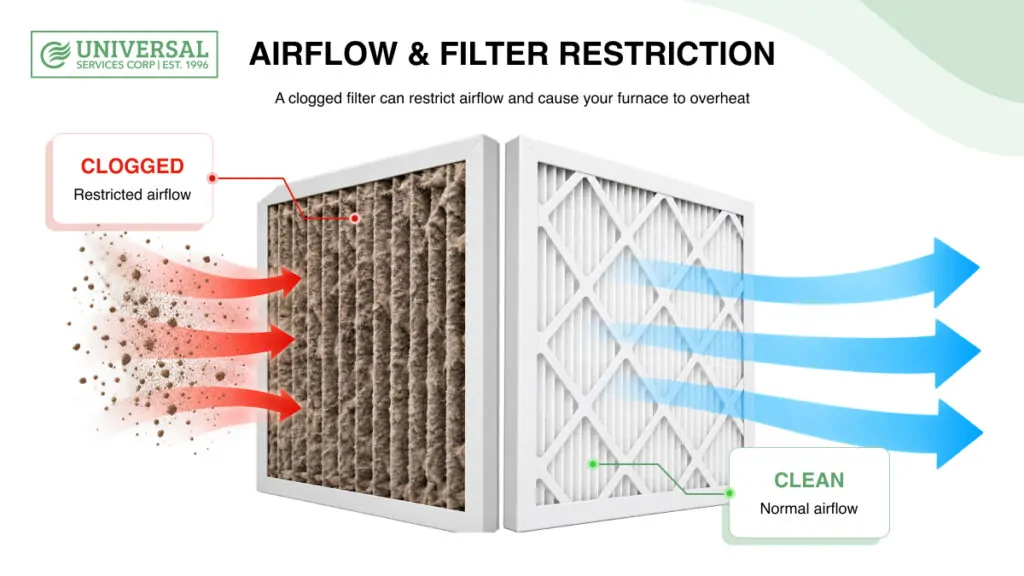
The control itself is another possibility. A defective limit switch can stop heating at the wrong temperature, while loose connections or a faulty control board can interrupt operation without actual overheating. A limit-related shutdown alone does not establish which component needs repair.
2. Thermostat Location, Wiring, or Configuration
The thermostat controls the call for heat, so inaccurate information at the wall often looks like a furnace fault. Direct sunlight, a nearby supply register, a kitchen appliance, or a draft affects the temperature it reads. Loose low-voltage wiring creates a different issue by interrupting the heating signal itself.
Pay particular attention to cycling that begins after a thermostat replacement. Honeywell Home explains that cycle rate determines the maximum number of times a heating system cycles within an hour under defined load conditions. An incorrect equipment type, cycle-rate setting, or wiring configuration often produces short cycles from the first day. Weak batteries are worth checking, but they are only one part of the thermostat diagnosis.
3. Flame-Sensor or Ignition Problems
Burners that light normally and shut off within a few seconds often point to a flame-proving problem. Once ignition occurs, the flame sensor must confirm that a stable flame is present. If the control board does not receive that signal, it closes the gas valve and stops the heating cycle.
A contaminated or damaged flame sensor is one possible cause, along with poor grounding, loose wiring, an unstable flame, or an ignition-control fault. Depending on the furnace model, the control board may repeat the ignition attempt before entering lockout.
4. Venting, Pressure-Switch, or Condensate Problems
Before ignition, the inducer motor establishes draft through the combustion-air and exhaust system. The pressure-switch circuit confirms that the furnace has a safe path for combustion gases. Snow, ice, debris, damaged venting, or weak inducer operation prevents that confirmation.
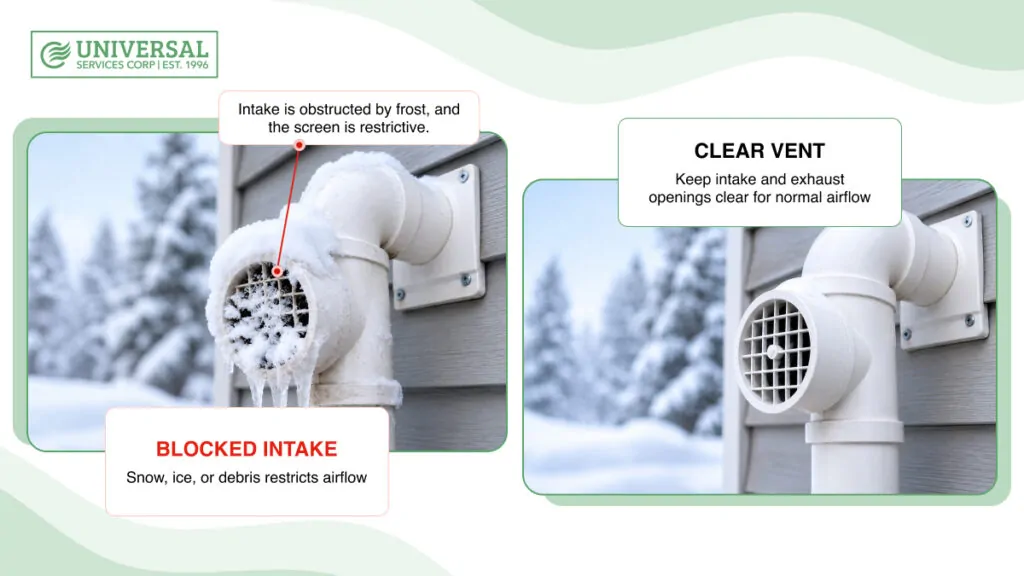
High-efficiency furnaces add another part to the sequence. Water produced during combustion must drain through the condensate trap and line. A blockage or backup interferes with draft and interrupts startup.
A pressure-switch code identifies the circuit that stopped the sequence, not necessarily a defective switch. The venting, drainage, tubing, inducer, and switch all require evaluation before any part is replaced.
5. An Oversized or Poorly Commissioned Furnace
An oversized furnace delivers more heat than the space requires. The area around the thermostat warms quickly, the heating call ends, and another cycle begins soon after the temperature drops. Rooms farther from the thermostat often remain less comfortable because the system does not run long enough to distribute heat evenly.
Poor commissioning produces a similar symptom when incorrect staging moves a multistage furnace to high fire too quickly or a heating-blower speed set too low triggers the high-limit control.
How to Prevent Furnace Short Cycling
Regular upkeep helps prevent airflow restrictions and keeps furnace components in good working order. Build these tasks into your maintenance schedule:
- Monthly during the heating season: Inspect the air filter, as ENERGY STAR recommends. Replace dirty disposable filters and follow the manufacturer’s maintenance instructions for your filter type.
- Throughout winter: Keep supply registers and return grilles clear of furniture and stored items. After heavy snowfall, check for snow buildup around accessible outdoor intake and exhaust openings.
- Once a year, preferably before the heating season: Schedule professional maintenance covering blower operation, cleaning as needed, electrical connections, and safety controls. Gas-furnace service should also include combustion, heat-exchanger, and venting checks. For condensing gas furnaces, include the condensate trap and drain.
When to Call a Professional for a Short-Cycling Furnace
Arrange an HVAC service visit if short cycling continues after the basic checks or the next step involves internal components. A technician will identify what interrupts the heating cycle before recommending a repair.
For suspected overheating, that means checking airflow and comparing the temperature rise across the furnace with the manufacturer’s specifications. On a gas furnace, testing also covers flame sensing, draft, and combustion as needed. Electrical measurements help distinguish a safety control reacting to a real problem from a fault in the switch, wiring, or control board.
If the problem began with a new installation, have the installer verify the heating-load calculation, heating-stage settings, and blower speed.
Our team at Universal Services Corp. provides HVAC diagnostics and repair in New York City and Nassau County. Call 347-380-8877 or contact our team to arrange a service visit.
Conclusion
Furnace short cycling does not point to a single failed component. The shutdown timing, thermostat status, blower behavior, and diagnostic code often reveal more than cycle length alone. Basic checks help rule out a loaded filter, closed registers, a thermostat issue, or a blocked exterior vent, but a repeating pattern calls for measured testing. Our technicians at Universal Services Corp. follow the same sequence-based process, using observed behavior and test results to determine why the heating cycle stops.
Frequently Asked Questions
Can an electric furnace short cycle?
Yes. Restricted airflow, overheating, or faulty electrical controls can interrupt heating in an electric furnace. Troubleshooting focuses on its airflow, heating elements, and controls. Gas ignition, flame sensing, and combustion venting are not involved.
Can a furnace short cycle without showing an error code?
Yes. If the thermostat ends a heating call too soon, the furnace can shut down as instructed without recording an internal fault. A normal status light therefore does not rule out short cycling.
Can furnace short cycling increase my heating bill?
Yes. The U.S. Department of Energy’s Building America Solution Center explains that repeated short cycling in combustion furnaces is inefficient. The effect on your bill depends on the equipment and the underlying problem; cycle frequency alone cannot establish the extra cost.
Is furnace short cycling dangerous?
Furnace short cycling is not always an immediate safety hazard, but the cause can involve overheating, venting, combustion, or electrical faults. Stop using the furnace and arrange service if you notice a gas smell, a carbon monoxide alarm, soot, sparks, repeated breaker trips, or unusual burning odors. Even without these warning signs, repeated short cycling should not be ignored because it increases wear and usually points to an operating problem that needs attention.
Does furnace short cycling mean I need a new furnace?
Not necessarily. Many cases involve repairable faults or incorrect settings. Replacement becomes worth considering when a furnace is substantially oversized or needs costly repairs near the end of its service life. Short cycling alone is not enough reason to replace the equipment.