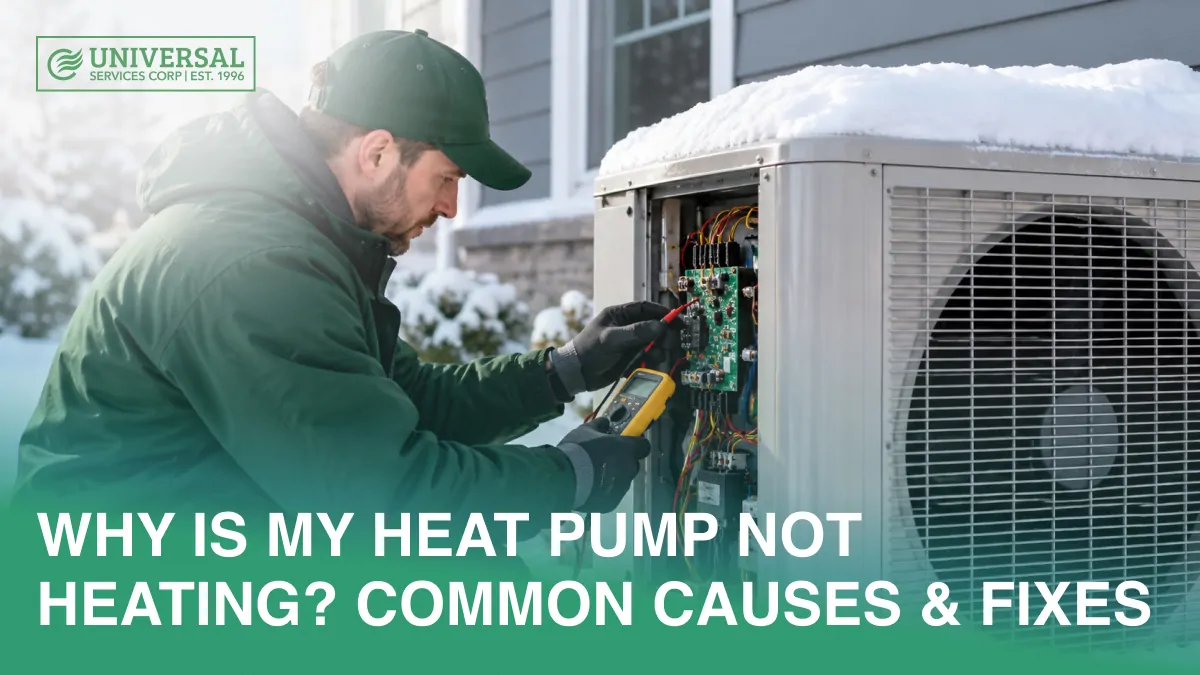
Your heat pump is running, but your home still feels cold? Don’t rush to replace it! A heat pump that isn’t heating may have a simple cause. Many homeowners are confused when something feels off because heat pumps operate differently from furnaces. Some “problems” are simply typical heat pump behavior before calling for service, while others undoubtedly require attention.
In this guide, we’ll explain the most common reasons a heat pump isn’t heating properly, what you can do to safely check it for issues yourself, and when it’s time to call for a professional HVAC technician.
Why Is My Heat Pump Not Heating?
Before diving into the topic in more detail, let’s look at the general causes to answer your main question of why your heat pump isn’t heating.
| Problem | Common Signs | DIY Check? | Professional Repair? |
| Incorrect thermostat settings | Cool air, system not heating | Yes | Sometimes |
| Dirty air filter | Weak airflow, poor heating | Yes | No |
| Frozen outdoor unit | Ice buildup, reduced heating | Limited | Often |
| Defrost cycle | Temporary cool air/steam | Yes, needs monitoring | Not necessary |
| Tripped breaker | System won’t run | Yes | If it happens again |
| Blocked outdoor unit | Poor performance | Yes | Sometimes |
| Faulty reversing valve | Heating doesn’t work, cooling may work | No | Yes |
| Low refrigerant | Lukewarm air, ice | No | Yes |
| Electrical/mechanical failure | Strange noises, shutdowns | No | Yes |
Before scheduling a repair, we recommend making basic checks that you can perform on your own to save time and money that otherwise would be spent on the service. Of course, if you have doubts or worries about doing it yourself, it’s better to entrust this task to an HVAC specialist. If DIY methods don’t work out, a professional inspection can determine the problem and conduct a quick repair.
Common Reasons Why Your Heat Pump Isn’t Heating
If you notice that your heat pump runs but no heat appears in your home, there might be some issues with its functioning that need fixing. Let’s look more closely at the most probable causes.
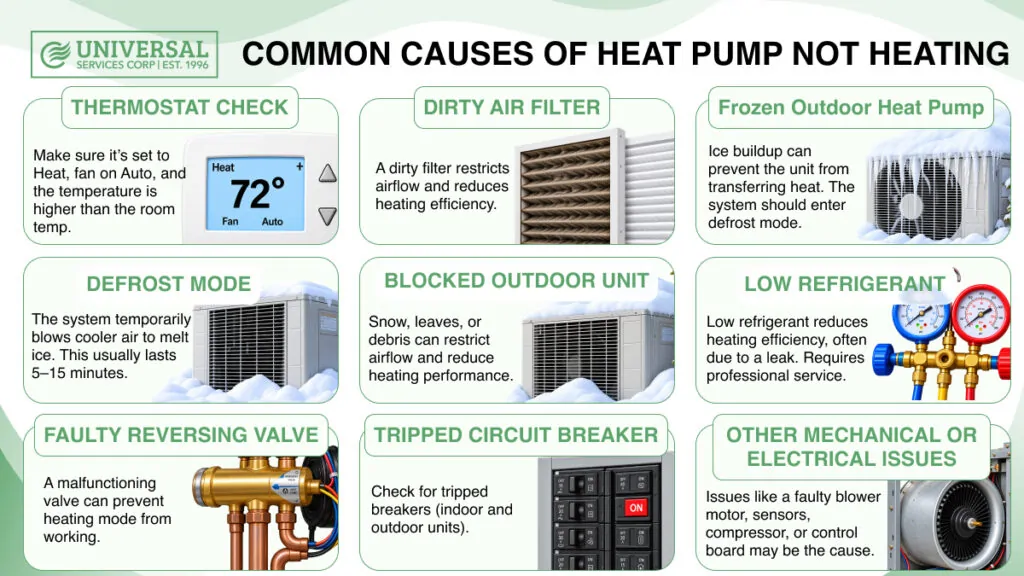
1. Your Thermostat Is Set Incorrectly
The thermostat is one of the first things we recommend checking when your heat pump isn’t heating.
Make sure it’s set to Heat, rather than Cool. Also check that the fan is set to Auto. If the fan is set to run continuously, it can circulate room-temperature air.
After that, examine the temperature setting as well. It should be higher than your current indoor temperature so the thermostat actually needs to heat up.
If you have a smart thermostat that adjusts settings on its own, look for error messages, connectivity problems, or schedule settings that could prevent the system from heating when you need it to. This is the simplest potential cause to eliminate.
2. Dirty or Clogged Air Filter
A dirty air filter can restrict the airflow in your HVAC system and reduce heating. When that happens, your heat pump may have to work harder to maintain the desired temperature.
There are signs of a clogged air filter that you may notice:
- Weak airflow from the vents
- Lukewarm air
- Longer heating cycles
- Uneven temperatures between rooms
- Higher energy consumption
- The system shutting down unexpectedly
Note: These same signs also may signify other heat pump problems. If you changed your filter but your heat pump keeps underperforming, there might be another cause that needs fixing.
Check the filter near your indoor air handler or return-air grille. If it’s visibly dirty, replace it with a suitable filter.
Regular filter replacement is also an important part of HVAC system maintenance. That’s why we recommend checking filters regularly, especially during winter when your heating is in heavy use.
3. Frozen Outdoor Heat Pump
A thin layer of frost on an outdoor heat pump can be normal during cold weather. However, heavy or persistent ice buildup can prevent the system from transferring heat efficiently.
If the outdoor coil becomes covered with ice, the heat pump may have difficulty extracting heat from the outdoor air. A properly functioning system should periodically enter defrost mode to remove this frost.
If you find ice on your outdoor unit, do not chip ice away with a tool. The outdoor coil contains delicate components you can damage in the process, which can lead to a more expensive repair. Instead of manually removing the ice, see if you can start a defrost cycle.
4. Your Heat Pump Is in Defrost Mode
In the winter, if your heat pump starts blowing cooler air all of a sudden, don’t assume it’s broken.
When ice develops on the outdoor coil, heat pumps may switch to defrost mode. In order to melt the accumulated ice, the system momentarily alters how it operates.
You might see:
- The outdoor fan stops momentarily.
- Steam emanating from the exterior unit; water or ice melting beneath it
- Air from inside vents is cooler.
- A little break from regular heating
After the operation finishes, the system should resume regular heating. A normal defrost cycle can last 5 to 15 minutes, but the exact time varies depending on the system and circumstances.
Defrost cycles may become frequent in cold, wet conditions. However, expert servicing can be required if the system regularly ices up, stays in defrost for an abnormally lengthy period of time, or is unable to return to normal heating.
5. The Outdoor Unit Is Blocked by Snow, Ice, or Debris
For your heat pump to function correctly, there must be enough airflow surrounding the exterior unit.
Make sure the unit isn’t obstructed by snow, leaves, branches, grass, or other debris during the winter. Maintain the manufacturer’s suggested clearance around the equipment and carefully remove any loose snow.
The heat pump may have to work harder if the external coil is blocked.
Instead of trying to disassemble or fix the equipment yourself, call an HVAC specialist if the unit is heavily frozen over or you are unable to properly remove the obstacle.
6. The Heat Pump Has Low Refrigerant
A heat pump that has low refrigerant may blow chilly or lukewarm air because the device is unable to transfer heat efficiently.
Potential indicators include:
- Inadequate heating efficiency
- Long or continuous operating cycles
- The outdoor coil is starting to create ice.
- The house doesn’t reach the thermostat setting
- An increase in energy use
Low refrigerant typically means that the refrigerant system has a leak or other issue. The cause cannot be solved by merely adding refrigerant without identifying and fixing the underlying issue.
Refrigerant diagnosis and repair should be done by an experienced HVAC professional since refrigerant systems require specific equipment and training.
7. The Reversing Valve Is Malfunctioning
In order to switch the direction of refrigerant flow between heating and cooling, a heat pump employs a reversing valve.
A broken or blocked reversing valve could be the reason your heat pump doesn’t heat your house even when it functions perfectly in cooling mode.
This is not a do-it-yourself fix for a homeowner. Professional HVAC expertise is needed to diagnose the valve, and refrigerant system maintenance may be necessary. A professional can test the system to see whether the issue is with the controls, reversing valve, or another part.
8. The Circuit Breaker Has Tripped
Look for a tripped breaker in the electrical panel if your heat pump isn’t operating at all.
It may be necessary to check multiple breakers because some heat pump systems have separate electrical circuits for the inside and outside equipment.
As directed by the equipment maker, you can reset a tripped breaker once. Don’t keep resetting it, though, if it trips again.
Frequent breaker trips may be a sign of a mechanical or electrical issue that needs to be diagnosed by an expert.
9. There is an Airflow, Mechanical, or Electrical Problem
The issue can be more complicated if your heat pump isn’t heating even though the thermostat, filter, power source, and exterior unit all seem normal.
Among the possible causes are:
- Restricted or leaking ductwork
- A blower motor that is failing
- A malfunctioning sensor
- Issues with defrost control
- Problems with the compressor
- Failure of an electrical component
- Issues with the control board
- Inadequate system sizing or installation
A trained HVAC specialist should evaluate these issues, which typically call for diagnostic equipment.
Heat Pump Is Not Heating in Winter: What Is The Issue?
The idea that heat pumps just stop functioning when the temperature drops below freezing is one of the most common myths about them.
In cold temperatures, modern heat pumps can still function. However, as external temperatures drop, heating efficiency and capacity typically decline, and some systems may use supplemental or auxiliary heat when more capacity is required.
The model, installation, system size, building features, and local environment all affect a heat pump’s precise performance.
This implies that a heat pump that operates for extended periods of time in cold conditions is not always damaged. Compared to conventional furnaces, heat pumps frequently deliver heat more consistently and at a lower supply-air temperature.
What Temperature Is Too Low for a Heat Pump?
Not every heat pump stops functioning at a specific external temperature. Modern cold-climate heat pumps are particularly made to function at considerably colder temperatures, but older systems may lose a considerable amount of heating capacity at lower temperatures. The anticipated operational range of a given system should always be ascertained using manufacturer specifications.
However, don’t automatically blame the weather for your heat pump’s inability to maintain a pleasant inside temperature during typical winter circumstances. The system may be undersized, improperly installed, misconfigured, or have a mechanical issue.
Heat Pump Blowing Cold Air: When Is It Normal?
Not every instance of your heat pump blowing cold air means your heat pump needs repair. Here are some of the cases when it’s totally normal compared with signs that indicate that the system has a problem.
| Usually Normal | Indicates a Problem |
|
|
DIY Fixes Checklist Before Calling an HVAC Technician
Start with the checks that are safe for the majority of homeowners if your heat pump isn’t heating:
Thermostat
- Is the temperature set to Heat?
- Is the temperature higher than it is now in the room?
- Is the fan in Auto mode?
- Do any error messages appear?
Air Filter
- Does it appear congested or unclean?
- Has it recently been replaced?
Outdoor Unit
- Is there snow or garbage all over it?
- Is there a lot of ice accumulation?
- Is there sufficient space for airflow within the unit?
Power Supply
- Is there a tripped breaker?
- After being reset, does the breaker trip once more?
However, if these simple checks don’t resolve the issue, you need to stop DIY troubleshooting and schedule expert heat pump servicing.
When to Call an HVAC Professional for Heat Pump Problems
As we already mentioned, certain heat pump issues shouldn’t be handled by do-it-yourselfers.
We recommend contacting an HVAC specialist if:
- The chilly air is still being blown by your heat pump.
- The system cannot reach the thermostat set temperature.
- The exterior unit is still somewhat frozen.
- The system frequently switches to or stays in defrost mode.
- The circuit breaker trips frequently.
- You think there may be a refrigerant leak.
- The heat pump produces strange sounds. Heating efficiency has abruptly decreased.
- The system turns on and off a lot.
- Your energy usage has unexpectedly surged.
Professional diagnosis is necessary for issues with refrigerant, electrical components, compressors, reversing valves, and control systems. Without the proper training, trying to fix these parts could harm the machinery and put people’s safety in danger.
Need Heat Pump Repair in New York City?
Our New York HVAC specialists can determine the reason why your heat pump isn’t heating your house and suggest the necessary fix.
Airflow restrictions, thermostat problems, frozen outside units, refrigerant issues, electrical faults, and heating system failures are among the main heat pump issues that we diagnose and fix.
How to Prevent a Heat Pump Heater From Not Working
Regular HVAC maintenance is the key strategy to keep your heat pump working effectively throughout the year. It can help identify concerns early on and prevent heating issues. Here are simple maintenance tips from our professionals that you can follow to keep your system running properly and last longer.
- Change or Clean the Air Filter
Appropriate airflow and effective operation require a clean filter. Regularly inspect it and replace it in accordance with the manufacturer’s instructions.
- Maintain a Clear Outdoor Unit
To ensure adequate ventilation, especially in the winter, clear the area surrounding the outdoor unit of snow, leaves, plants, and debris.
- Plan for Expert Heat Pump Maintenance
HVAC specialists, like the Universal Services Corp. team, can examine airflow, coils, electrical components, refrigerant, and overall system function during annual maintenance.
- Keep an Eye Out for Performance Shifts
If you experience longer heating cycles, greater energy costs, uneven heating, strange noises, frequent defrost cycles, recurrent ice accumulation, or trouble keeping the thermostat set, get in touch with our HVAC specialist.
Conclusion
Now you know the most common reasons why your heat pump isn’t heating, which of these issues you can fix yourself and which ones require professional assistance. An annual tune-up, routine cleaning, and brief inspections keep everything functioning properly. It’s common for a heat pump to warm a house more slowly than a furnace.
A brief phone call to an expert might save time and frustration if it is still not heating. For more assistance, the staff at Universal Services Corp. can identify and fix heat pump issues in residences around New York City.
Heat Pump Not Heating FAQ
Why is my heat pump blowing cold air?
Verify the thermostat settings or see if it is temporarily in defrost mode. You most likely have a refrigerant problem or a malfunctioning reversing valve if the settings are accurate and the cold air is consistent.
What temperature causes heat pumps to stop working?
Before their effectiveness drastically decreases, modern heat pumps operate at temperatures as low as 25 to 30°F. They just become less effective and backup heat takes over, but they do not cease to function.
Is it typical for my heat pump to run continuously?
Longer cycles are typical, but if it never reaches the set temperature, there is a problem—low refrigerant, an undersized system, or technical issues.