A furnace that stopped working in a commercial or residential property poses the risk of major problems for your business and discomfort at home. Whether you manage a retail space in Manhattan, a warehouse in Brooklyn, or an apartment building in Queens, when your furnace won’t heat, you need a quick diagnosis and a simple solution before calling a professional.
As HVAC professionals, we’ve compiled a comprehensive guide to troubleshooting furnace problems. Learn the most common causes and 8 practical steps to solve the problem before calling a professional.
‼️If you smell gas, leave the building immediately and call the gas company from outside. Do not turn the furnace back on.
Repairing Furnace: Where to Start
The most common furnaces in the New York City area are gas-fired models, so we’ll start by focusing on gas furnace troubleshooting. Many of these tips apply to propane and oil furnaces as well, so you can use this guide for them too.
Is your furnace working but not blowing any warm air? Or does it not start at all? The problem isn’t always a complicated one, and there are ways to fix it yourself in 5-10 minutes. So before you call an HVAC service and overpay for an emergency call, save yourself time and money by diagnosing the problem using our guide and getting your system back up and running.
From our experience, we can assure you that about half of the “furnace on but no heat” calls we receive in New York turn out to be easy to fix. Here’s a step-by-step troubleshooting checklist so you’ll know how to fix the problem yourself or what to tell the technician when you call to save time.
8 Oil and Gas Furnaces Troubleshooting Steps
1. Furnace Not Responding to Thermostat
Check the thermostat.
The most common reason for requests such as “My gas furnace not heating” is the thermostat itself, so it’s worth checking it first. To troubleshoot a furnace not keeping up with thermostat, check the following:
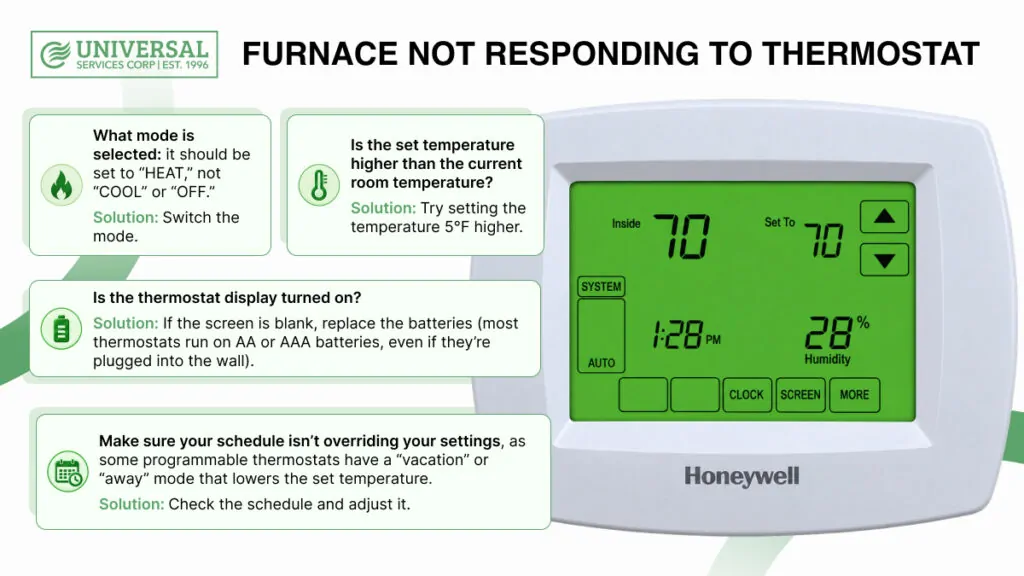
- What mode is selected: it should be set to “HEAT,” not “COOL” or “OFF.”
Solution: Switch the mode.
- Is the set temperature higher than the current room temperature?
Solution: Try setting the temperature 5°F higher.
- Is the thermostat display turned on?
Solution: If the screen is blank, replace the batteries (most thermostats run on AA or AAA batteries, even if they’re plugged into the wall).
- Make sure your schedule isn’t overriding your settings, as some programmable thermostats have a “vacation” or “away” mode that lowers the set temperature.
Solution: Check the schedule and adjust it.
If you have a smart thermostat from brands such as Nest, Ecobee, Honeywell, or others, check the specialized app for any error messages or low-battery warnings.
2. Furnace Not Turning On
Check the furnace switch and breaker. Every furnace has a special light switch, usually red in color, located next to the device that supplies power to the furnace’s control board. Occasionally, the property owner, an electrician, or a contractor turns it off and forgets to turn it back on.
Solution:
1. Make sure the switch is in the “ON” position.
2. Next, check the electrical panel, locate the circuit breaker labeled “Furnace” or “Heating,” and make sure it is in the “ON” position and has not tripped (a tripped circuit breaker will be in an intermediate position).
3. Reset it by flipping it all the way to the “OFF” position and then back to “ON.”
3. Furnace Not Working
Read the diagnostic light on the control board. Most oil and gas furnaces have a built-in diagnostic function that allows you to instantly identify exactly where the problem lies in the system. To avoid having to check each part of the system separately, we recommend using this diagnostic function first.
The furnace has a control panel with a diagnostic LED that blinks to indicate the nature of the problem. To access it, open the small access panel on your furnace, which is usually located at the front, slightly above the burner area. The LED you need is already blinking in a specific sequence, for example, 3 flashes, a pause, then 3 more flashes.
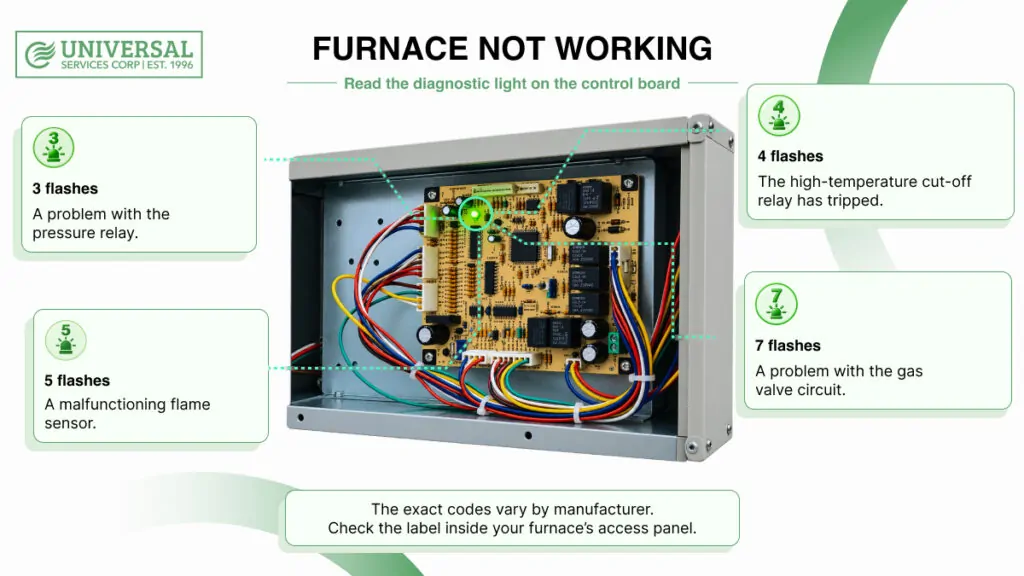
Each code corresponds to a specific diagnostic message in the furnace’s manual. The exact codes vary by manufacturer. To find the codes for your model, check the label inside your furnace’s access panel. If you can’t find the codes for your specific model, you can refer to our list. We’ve compiled the most common LED codes. Compare them to your furnace’s blinking pattern to identify the problem:
- 3 flashes indicate: A problem with the pressure relay. This is often caused by a clogged vent pipe.
Solution: Check the outdoor vent for snow, leaves, or debris and clean it out.
- 4 flashes indicate: The high-temperature cut-off relay has tripped. This means the unit overheated, which is usually caused by a dirty filter or blocked airflow.
Solution: Check the filter, replace it if it’s too clogged, if no call for service.
- 5 flashes indicate: a malfunctioning flame sensor.
Solution: Call a technician to clean soot from the flame sensor. They will clean it with special tools in 5-10 minutes.
- 7 flashes indicate: a problem with the gas valve circuit.
Solution: Follow our next steps to determine exactly where in the circuit the problem lies.
If you can’t find an LED on your furnace, or can’t find the manual for your specific model, and our common manual hasn’t been very helpful, move on to the more specific solutions we’ll describe below.
4. Furnace Overheats
Inspect the air filter. Furnaces often overheat and shut down into safety mode simply because of clogged air filters. However, when this happens, they can often turn back on by themselves, but only after they’ve cooled down for 15–30 minutes, which is still quite a long time. A severely clogged filter will cause these overheats and resulting shutdowns to occur constantly.
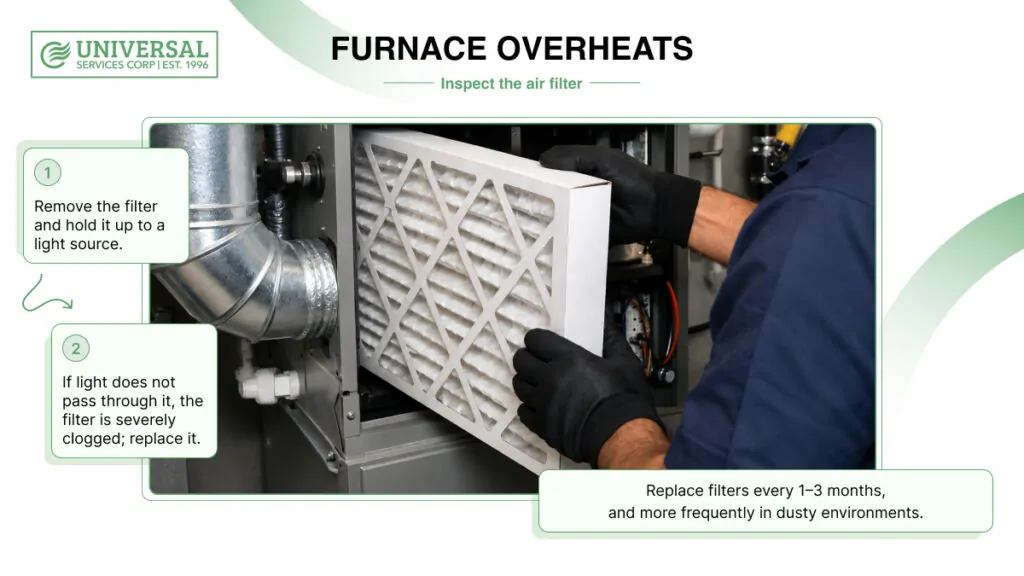
Solution: Remove the filter and hold it up to a light source. If light does not pass through it, the filter is severely clogged; replace it.
To prevent such overheating from occurring and recurring, filters should be replaced every 1-3 months in most commercial spaces, and more frequently in areas with high foot traffic or in dusty environments.
5. Gas Furnace Not Igniting
Check the gas supply. Now let’s check the most important thing: the gas supply to the furnace.
- First of all, the most basic thing is the valve; it should be positioned parallel to the gas line, which is the open position.
Solution: Move the valve to the open position (parallel, not perpendicular) if it is closed.
- Before continuing with troubleshooting, check the overall gas supply by verifying whether other gas appliances in the building are working.
Solution: If the other appliances also won’t ignite, this means the gas supply has been cut off; call the gas utility company.
‼️If you smell gas, leave the building immediately and call the gas company from outside. Do not turn the furnace back on.
6. Furnace Starts Then Shuts Off
Most modern gas furnaces often have a built-in flame sensor that confirms the gas has ignited. It looks like a small metal rod near the burners. Over time, without maintenance, the sensor can become coated with soot, which prevents it from detecting the flame; as a result, the furnace shuts off almost immediately, after 5-10 seconds.
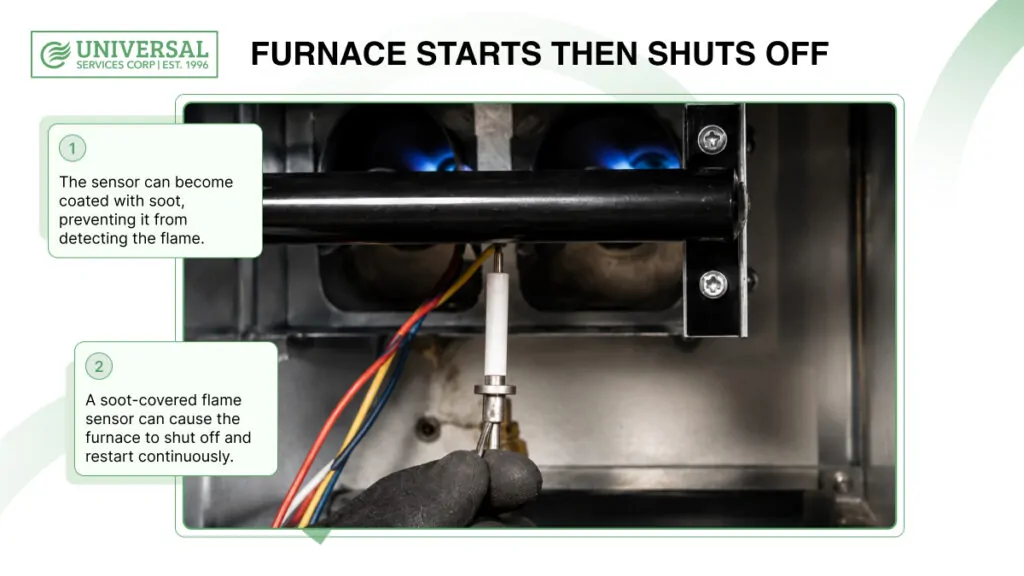
If the furnace starts up, runs for a short time, then shuts off and restarts in a continuous cycle, this is often caused by a soot-covered flame sensor.
Solution: Unfortunately, we do not recommend cleaning the sensor yourself, as it will be inefficient. However, once you’ve identified this problem, you can report it when you call for service. Cleaning the sensor takes about 10 minutes for a technician with the proper tools.
7. Furnace Leaks
Check the condensate drain. Less common high-efficiency (AFUE 90%+) furnaces produce condensate as a byproduct of combustion. This condensed water is drained through a pipe to a floor drain or a condensate pump.
Occasionally, you may encounter a serious problem such as a clogged drain pipe or a simple pump failure. As soon as either of these issues occurs, a safety cut-off shuts down the furnace to prevent flooding. Puddles on the floor near the furnace are often a sign of a clogged drain.
Solution: A clogged drain pipe can be cleared using a wet/dry vacuum cleaner by placing it over the drain opening. If the problem is a malfunctioning condensate pump, you’ll need to call a service technician.
8. Furnace Running But Not Heating
Listen for the inducer motor. Another reason why the heater running but no heat is a common thermostat signal issue. When you set the thermostat to a temperature higher than the room temperature, your furnace should initiate a specific sequence of actions: the inducer should start emitting a low hum, then the igniter makes a clicking sound, after which the burners ignite, and finally, after about 30-60 seconds, the blower begins to circulate warm air.
If you don’t hear anything after the heating signal is sent, the problem is either that the thermostat signal isn’t reaching the furnace or the control board, or that the unit isn’t receiving power.
Solution: If you hear the inducer humming but ignition does not occur, the problem is likely with the igniter, the gas valve, or the flame sensor. These issues require a service call.
When to Call a Specialist for Furnace Repair or Maintenance
If, after trying all the troubleshooting steps, you haven’t managed to resolve the issue, it’s important to know when to turn to the experts. This is crucial for preventing further damage and ensuring the safety of your property. Contact an HVAC service specialist if:
- There is no improvement after trying the troubleshooting steps we mentioned. If your attempts to fix the problem have been unsuccessful, the issue is more serious and cannot be resolved without a technician. Do not delay furnace diagnostic and repairs if it is already showing signs of trouble, as continued operation will lead to further damage and higher repair costs.
- Gas leaks or unusual odors. A noticeable smell of gas or any unusual odors are signs that require immediate professional intervention. As soon as you smell something like this, immediately turn off the furnace system and evacuate the building. A gas leak is dangerous and requires immediate attention from a qualified technician.
- Electrical issues. Problems with the electrical components of your heating system must be addressed by a professional. These include issues such as malfunctioning thermostats, wiring problems, or control board malfunctions.
- Constant turning on and off. If your furnace keeps turning on and off, this may indicate overheating or a faulty thermostat. A technician can diagnose and fix this problem.
- Insufficient heating. If our tips haven’t helped provide enough heat, the problem may be more complex and related to issues with the fan motor, heat exchanger, or other internal components. These problems require the qualified intervention of a professional technician.
- Carbon monoxide detector alarm. If your premises are equipped with carbon monoxide detectors and one of them has gone off, this may indicate a leak or improper fuel combustion in your furnace. Evacuate the building and call for professional help immediately.
- Age and prolonged lack of maintenance. If your furnace is nearing the end of its service life and has not been properly maintained, it is recommended that you have a specialist inspect it. They will be able to assess its condition and advise you on whether it is time to replace it.
You can schedule a service call right here. At Universal Services Corp., we are local specialists in residential and commercial furnace repair throughout the New York area. We’ve been providing our services for nearly 30 years, and our technicians are properly trained, certified, and licensed.
Feel free to call us right now to request emergency furnace fix or fill out the form to schedule maintenance.
Conclusion
If your furnace not running, it can be not only a problem for heating but also a safety hazard. Before attempting to fix the problem, make sure you don’t smell anything suspicious. Solutions to a lack of heat can be quick and relatively simple; to diagnose the issue, we recommend first checking the indicator LED. If that doesn’t help, proceed to the other steps we’ve suggested.
If none of our steps have helped, the problem is more complex, and the best solution is to call a technician immediately to avoid any delays. Call Universal Services Corp. at any time of day to request immediate service or schedule a maintenance appointment.
Frequently Asked Questions
What are the most common commercial furnace problems?
The most common problems with commercial furnace systems include clogged air filters, fan motor malfunctions, and thermostat issues. These problems arise due to a lack of regular maintenance. Damage to the heat exchanger is less common but can be very dangerous. A cracked heat exchanger can cause a carbon monoxide leak and requires immediate attention from a professional.
When should I call a technician instead of troubleshooting myself?
Contact a licensed HVAC professional if:
- You smell gas
- A carbon monoxide detector has gone off
- Your furnace is running, but only in short cycles
- The diagnostic LED on the control panel displays a code that cannot be cleared using basic troubleshooting steps.
Who do I call when my furnace is not working in New York?
For commercial furnace repairs in New York City and the surrounding areas, contact Universal Services Corp. We offer 24/7 emergency service for heating, ventilation, and air conditioning systems throughout Manhattan, Brooklyn, Queens, the Bronx, Staten Island, and the greater New York City area.