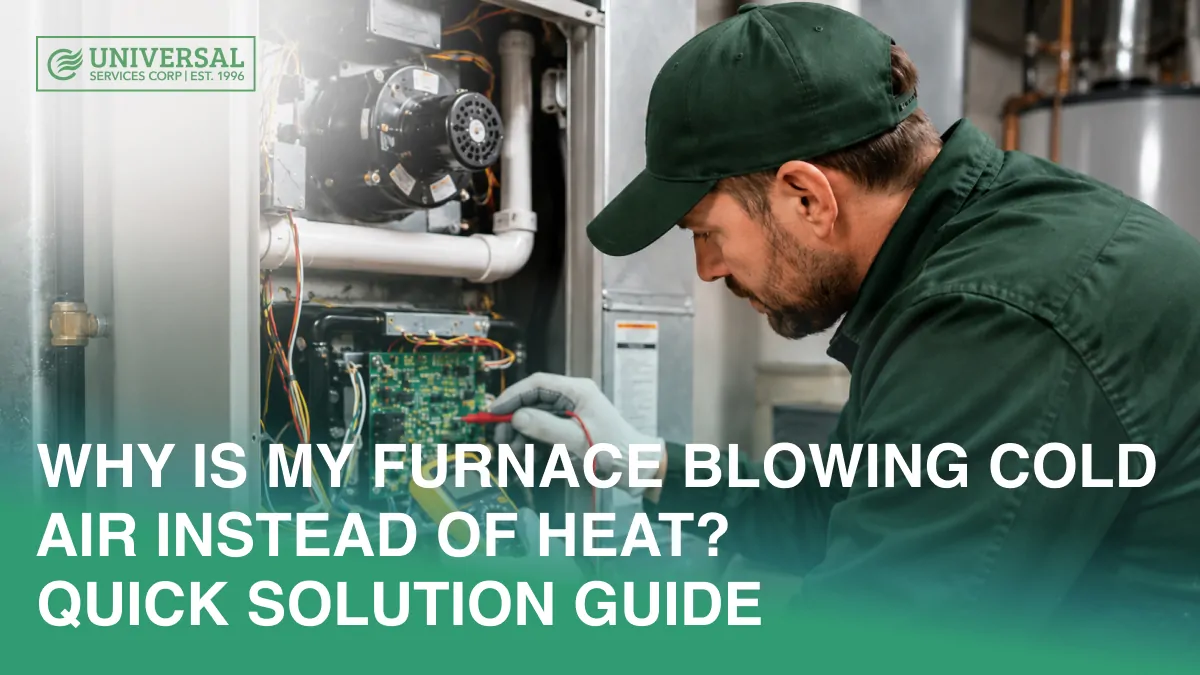
Sometimes, when you need a warm space in a commercial or residential building, the furnace suddenly starts blowing cold air and doesn’t even heat up. The causes can range from the simplest and most common to more serious issues that arise from a lack of maintenance.
Together with our technical specialists at Universal Services Corp., we’ve compiled a list of the most common reasons why a furnace is blowing out cold air. To help you address these issues, we’ve compiled a simple guide based on our experience. In case of more serious problems, we’ve provided you with contact information for a professional service provider. Read on and stay warm.
11 Primary Reasons Why a Furnace Blows Cold Air Instead of Warm
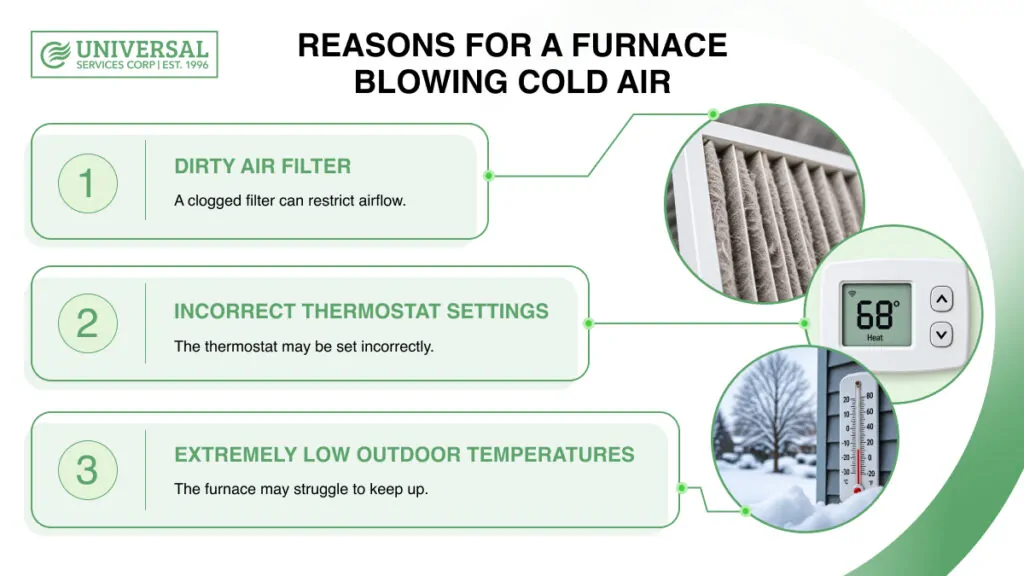
First, let’s identify why your furnace is blowing cold air instead of warm air, and how to fix it. The most common causes include:
1. The Thermostat is Set to “On” Instead of “Auto”
Signs: The fan runs continuously, but only cold air is coming out, and it does not heat up, while the furnace shows no unusual signs.
This is the most common and simplest reason why the furnace is running but not blowing hot air. Thermostats have two fan operating modes: “On” and “Auto.”
- In “On” mode, the fan runs continuously, even when the furnace isn’t heating the air.
- In “Auto” mode, the fan runs only during heating cycles. It turns on after the heat exchanger heats up and turns off when the thermostat reaches the set temperature.
Solution
Go to the thermostat and make sure “Auto” mode is selected instead of “On” mode. After switching, warm air should start flowing almost immediately, as soon as the furnace warms up a bit.
2. The Thermostat is Set to “Cool” Mode or the Other
Signs: The furnace is operating normally, but the air remains cold regardless of how high the temperature is set.
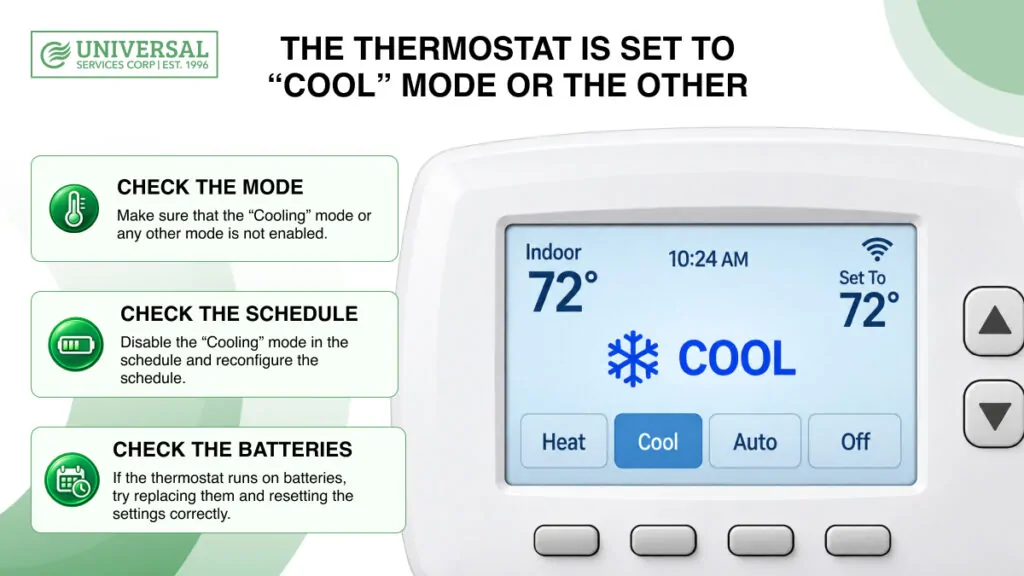
During service calls, we often find that the thermostat may have been accidentally bumped or switched to the wrong mode. On modern thermostats, in addition to “Off”, “On”, and “Auto” modes, there are also “Cooling” and other modes. In “Cooling” mode, no matter how high you set the temperature, the air will remain cold. Additionally, modern heaters have programmable thermostats that can operate according to a set schedule.
Solution
- If your furnace has additional modes, make sure that the “Cooling” mode or any other mode is not enabled.
- If you have a smart furnace, review its settings, disable the “Cooling” mode in the schedule, and reconfigure the schedule.
- If your thermostat runs on batteries, it may display incorrect readings when the batteries are low. Try replacing them and resetting all the settings correctly.
3. Dirty or Clogged Air Filter
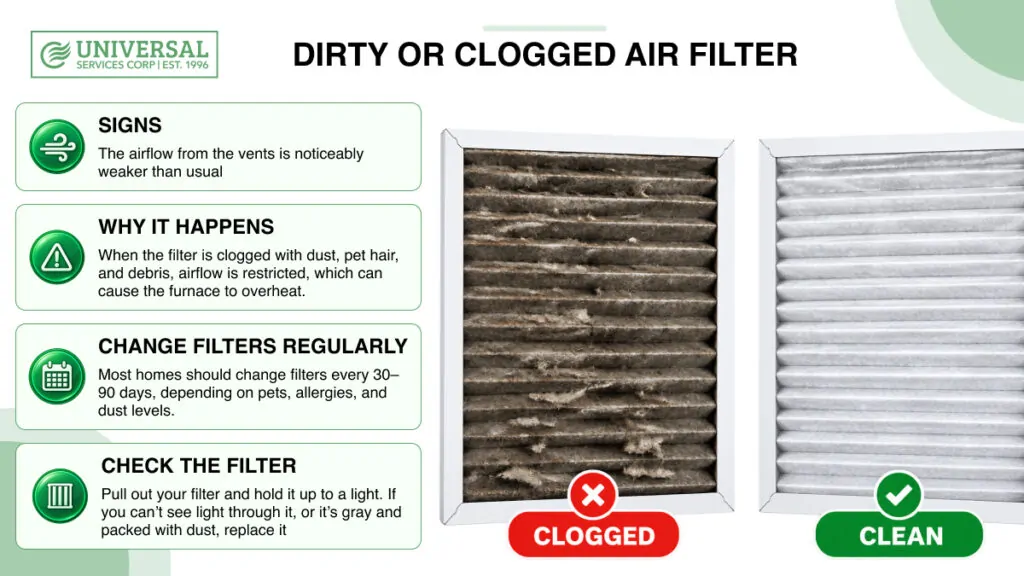
Signs: The airflow from the vents is noticeably weaker than usual. The furnace seems to be overheating. The furnace cycles on and off by itself.
Another common cause is a dirty air filter. When the filter is clogged with dust, pet hair, and debris, airflow is restricted. This restricts airflow to the heat exchanger, causing the furnace to overheat. When the furnace overheats, it automatically shuts off for safety reasons to allow it to cool down. However, the fan often continues to run to cool the system, which is why cold air is coming out of the vents.
Solution
Pull out your filter and hold it up to a light. If you can’t see light through it, or it’s gray and packed with dust, replace it. Most homes should change filters every 30-90 days, depending on pets, allergies, and dust levels. For commercial establishments, the recommendations are the same, with the exception of businesses involving intensive work and dusty air.
Replacing air filters regularly is also important for saving money, as according to the U.S. Department of Energy, a clogged air filter causes an HVAC system to use up to 15% more energy, which increases the amount on your bill.
4. Pilot Flame Extinction (Typical for Older Furnaces)
Signs: You have an old furnace manufactured before 1990; when you turn it on, you either don’t see a flame in the viewing window or the flame goes out.
In older gas furnaces manufactured before 1990, a pilot flame is used to ignite the burners. This small, constant flame ignites when the thermostat signals the need for heating. However, this pilot flame is unstable and may fail to respond to the thermostat’s signal or simply go out early, before the main burners ignite. In this case, the blower will continue to supply air, but it will be cold.
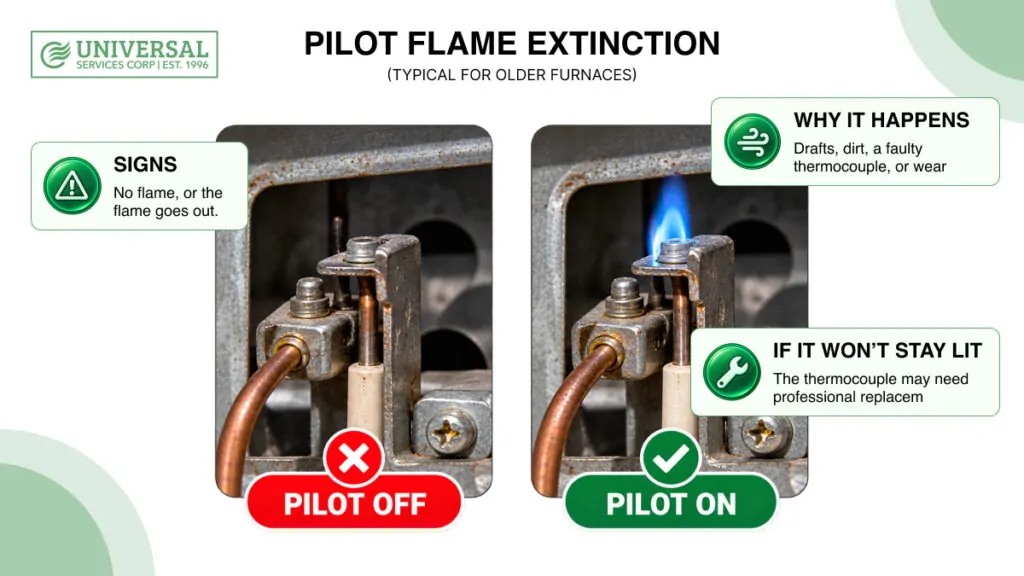
The unreliability of this ignition method is further underscored by the reasons why the pilot flame may go out. Pilot flames can go out due to ordinary drafts, dirt buildup in the flame port, a faulty thermocouple, or simply due to wear and tear.
Solution
Nevertheless, if the pilot flame fails to ignite or goes out quickly, you can light it yourself by following the instructions:
In most such furnaces, you usually need to turn the gas valve to the “Off” position, wait a few minutes, turn it to the “Pilot” position, and hold down the ignition button until the flame ignites. Once the flame has burned for about 30 seconds, turn the valve back to the “On” position.
If the pilot flame does not stay lit after relighting, the thermocouple is likely faulty. Only a qualified technician can resolve this by replacing it in accordance with safety regulations.
5. Dirty Flame Sensor
Signs: You hear a sound of the burners igniting and then going out, but the furnace does not start heating and does not stay lit.
Unlike the older furnaces we discussed above, modern furnaces use electronic ignition and a flame sensor to ensure safer operation. This sensor looks like a small metal rod located near the burners, which confirms the presence of a flame.
The sensor’s job is to monitor the ignition of the burners to ensure safety in the case of a malfunction. If no flame is detected, the gas valve closes within a few seconds for safety reasons. Due to its proximity to the flame, over time, the sensor may become coated with soot, carbon deposits, or corrosion, which will prevent it from detecting the flame. In this case, the furnace will cycle on and off repeatedly, while the fan may continue to run, blowing cold air into the building.
Solution
Cleaning the flame sensor requires working near gas and electrical components. If you do not have the necessary experience in heater maintenance, we strongly advise against attempting to clean it yourself. To clean the sensor, call a qualified technician who can safely clean everything using specialized tools.
6. Activation of the Limit Switch Due to Overheating
Signs: The furnace operates in short cycles, turning on and off more frequently than usual.
A safety device called a limit switch is built into the furnace to maintain the internal temperature at a safe level. If the system overheats, the limit switch will shut off the burners and keep the fan running to cool the equipment.
We’ve already mentioned that a furnace can overheat due to blocked air circulation, but faulty fan motors can also be a cause. The limit switch itself can also malfunction and trip early.
Solution
First and foremost, make sure nothing is blocking air circulation, that the air filter is clean, and that all vents are fully open. If this doesn’t help and the furnace continues to run in short cycles, contact a professional to check the limit switch and thoroughly inspect the airflow system.
7. Too Many Closed Vents
Signs: Some rooms are noticeably colder than others, the system is running louder than usual, or the furnace is cycling on and off frequently.
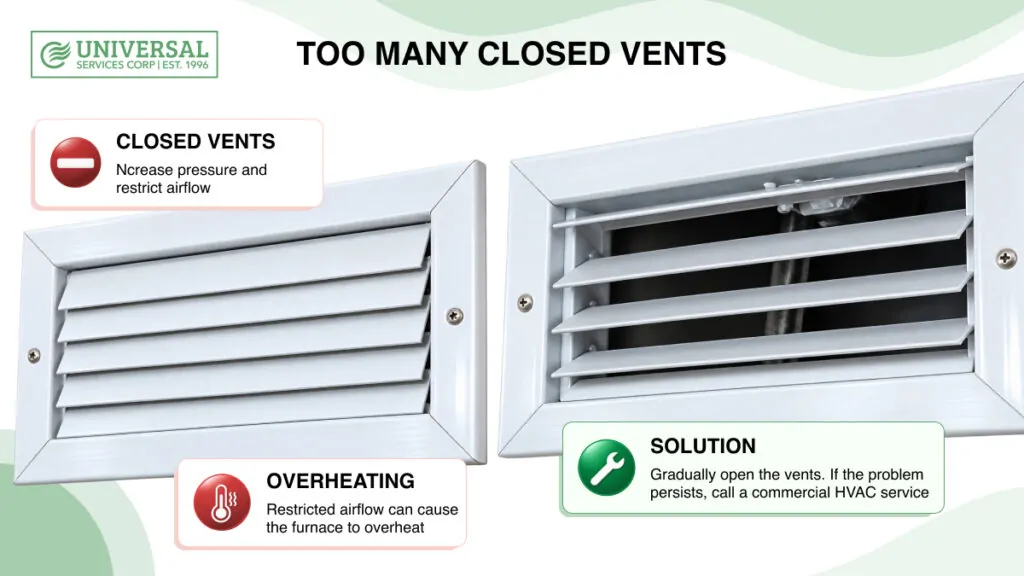
There is a common misconception that closing the air vents in rooms that don’t need to be heated reduces energy consumption and, as a result, heating costs, but that’s not true and can even lead to serious malfunctions.
With each vent you close, you increase the pressure inside the duct system. This additional resistance restricts airflow, leading to overheating and the limit switch tripping. The furnace begins to overheat quickly and shut off, while the fans continue to circulate air regardless of its temperature.
Solution
Gradually open the ventilation openings in your building. If this resolves the issue, you have addressed the circulation restriction. If the problem persists and the symptoms remain the same, call a commercial HVAC service to inspect your ductwork system.
8. Low Gas/Oil Supply
Signs: The furnace takes a long time to ignite or shuts off immediately after ignition. Other gas appliances in the building may also operate intermittently.
If, for any reason, the gas supply is weak or interrupted, the safety system shuts off the burners, and the fan may continue to blow cold air. It’s possible that your gas valve isn’t fully open, or that your supplier has temporarily cut off the supply due to maintenance. For propane systems, another common cause is a low or empty tank.
Solution
Make sure the gas valve is fully open by turning it parallel to the pipe. If you have an oil furnace, check the fuel level in the tank. If this isn’t the cause, check other gas appliances in the building. If they also lack a gas supply, contact your gas provider. Any further inspection of valves, piping, or burners must be performed by a licensed technician.
9. Blocked Condensate Drain Line (High-Efficiency Furnaces with an AFUE ≥ 90%)
Signs: Water accumulates around the furnace. The unit turns on, but the burners do not ignite.
High-efficiency furnaces are so powerful that, as heat is extracted from the combustion products, water vapor condenses into liquid inside the heat exchanger. Manufacturers have accounted for this in the design, and this water is drained through a condensate drain line. It usually looks like a standard white PVC pipe and leads to a floor drain or a pump.
Over time, this drain line can become clogged with algae, mold, or dirt. This causes water to flow back into the unit, causing the built-in safety switch to shut off the burners to prevent damage, while the fan may continue to run, blowing cold air.
Solution
You can clear minor clogs on your own. Simply disconnect the pipe carefully and flush it out by hand or with a wet vacuum. If you’re unsure about this procedure, call a technician.
10. Air Leaks from Ducts
Signs: The air coming from the vents isn’t warm enough. Heating bills are rising for no apparent reason. You can feel air leaking from the ducts.
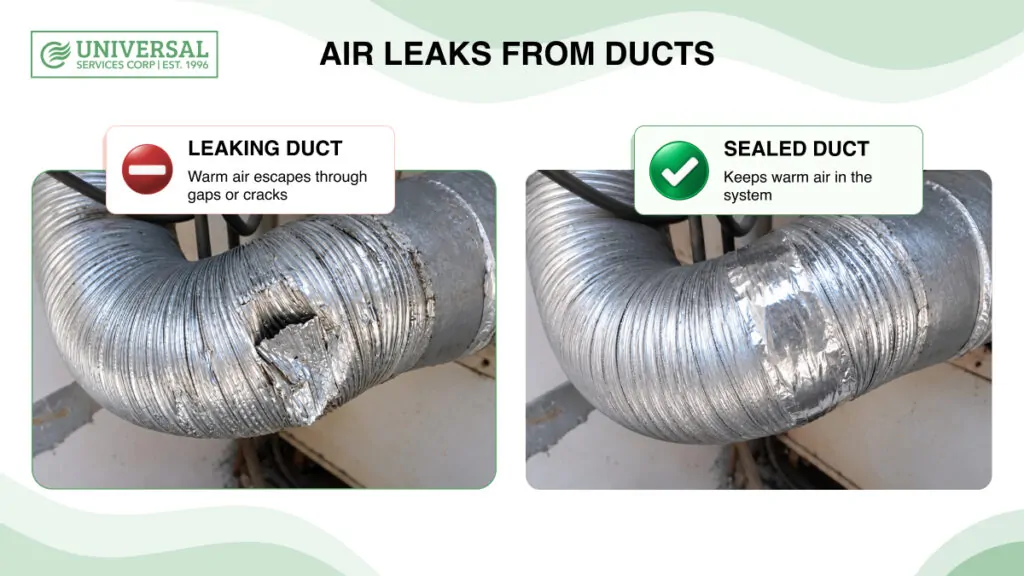
As experts in heating, ventilation, and air conditioning systems, we often notice during service calls that loose connections were made when the air ducts were installed. Cracks may also develop over time, allowing warm air to escape into unheated areas such as attics or basements. As a result, you’re sharing your warm air with these rooms, while cold air from them is drawn back into the system and mixes with the heated air, significantly lowering the supply temperature.
According to ENERGY STAR, about 20 to 30 percent of the air moving through the duct system is lost due to leaks, holes, and poorly connected ducts.
Solution
Locate the leak by running your hand along the accessible air duct joints. Visible gaps can be sealed with simple metallized adhesive tape or mastic sealant. If you suspect air ducts hidden behind walls or in hard-to-reach places, an HVAC specialist can perform a pressure test and carry out professional sealing.
11. Faulty Control Board
Signs: The room temperature fluctuates unstably. The furnace skips steps in its normal startup sequence. Error indicators are flashing on the control panel.
Modern furnaces are controlled by a computerized control board. If this board fails, the fan may continue to run independently of the heating system.
Solution
Carefully remove the furnace access door and check whether the LED indicators on the control board are flashing. The flashing pattern corresponds to specific diagnostic error codes. Record the exact flashing sequence and contact a qualified technician to decode the error and perform the necessary repairs.
How Long Will It Take to Resume Warm Air?
Once you or a called-in specialist have resolved the issue of the furnace not blowing heat, it usually takes 5 to 15 minutes for the warm air to resume, depending on the type of furnace and the type of repair.
The reason is that after the unit is restarted, the burners or heating elements need some time to warm up, after which the fan will turn on and distribute the warm, heated air.
If a significantly longer time has passed and the heater still blows cold air, the problem may not have been resolved and requires further diagnosis and repair.
When Professional Help is Needed for a Heater Blowing Cold Air
If you’ve checked and ruled out all the main causes we listed above, including the thermostat and filter, but the furnace is blowing cold air on heat or has other obvious malfunctions, we recommend that you don’t waste any time and call a certified HVAC technician.
Call Universal Services Corp. if your furnace shows any of the following signs:
- Short operating cycles: The furnace turns on and off too frequently.
- Unusual noises: The unit emits unusual knocking, rattling, or squeaking sounds.
- The pilot light won’t stay lit: This often indicates a problem with the thermocouple or the gas valve.
- High utility bills: A sudden spike in your bills indicates that the system is running in overdrive to compensate for a malfunction or leak.
Our technical specialists accept service requests in New York and Nassau County 24/7, including weekends, and will arrive on-site within an hour. We also offer emergency rates if you need urgent repairs or smell gas. ‼️If you smell gas, leave the building immediately and call the gas company from outside. Do not turn the furnace on.
Preventing A Heater Blowing Cold Air
To prevent system malfunctions and control panel errors that cause the furnace to blow only cold air, simply follow these 3 steps:
- Schedule or sign a contract for annual professional furnace maintenance. (For commercial facilities with increased workload, more frequent maintenance is recommended.)
For scheduled maintenance, you can contact Universal Services Corp. We offer reliable maintenance contracts for all HVAC systems. Complete the request form, and we’ll contact you as soon as possible to provide the services you need.
- Replace air filters regularly before they become too clogged. To maintain clean air and system reliability, change the filter every 1-3 months. The frequency depends on the furnace’s workload and the room conditions.
- Fix leaks in the air ducts as soon as you suspect or find them. When having your furnace serviced by a professional, ask them to inspect the air ducts to ensure that your heat isn’t leaking beyond the intended area.
Conclusion
It often happens that a furnace starts blowing only cold air without heating up. Solutions to this problem range from a few simple fixes that can be resolved in 5 minutes to more complex ones that require the assistance of a specialist. If you’re facing this issue, to save time and money, first go through our guide to solving the most common problems.
If the guide didn’t help or you suspect that the problem is much more complex, request a service or call Universal Services Corp. for a quick resolution at any time of day.